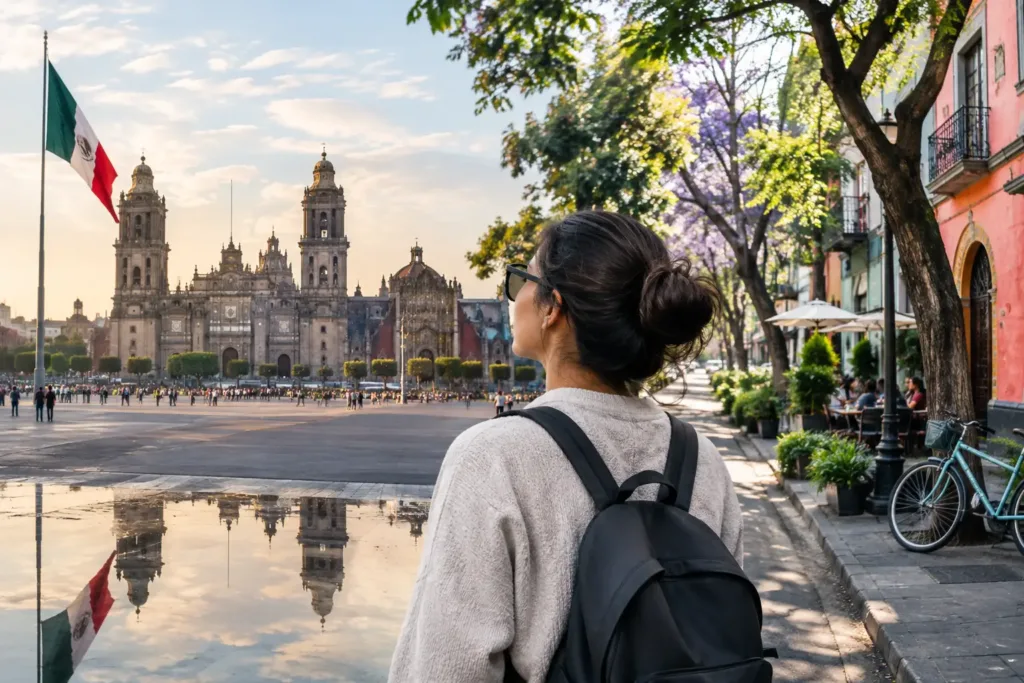
A tilted sidewalk in Roma, a church that seems to sit lower than the street, a puddle lingering after an afternoon storm: why Mexico City sinks is not an abstract geology lesson. It is part of the city’s texture. Once you notice it, you begin to read CDMX differently – in the uneven stone, the leaning facades, and the way water still shapes a metropolis built over an ancient lake.
For travelers, this history offers more than a surprising fact. It explains why certain neighborhoods feel the way they do, why rain can transform a commute, and why the city’s relationship with water remains one of its most urgent and fascinating stories.
Mexico City was built in a lake basin
Long before Mexico City became one of the world’s largest urban centers, the Valley of Mexico held a network of lakes. The Mexica capital of Tenochtitlan stood on an island in Lake Texcoco, connected to the shore by causeways and sustained by canals, dikes, and chinampas – highly productive agricultural gardens built in shallow water.
This was not a city fighting its environment. It was a city designed around it.
After the Spanish conquest, colonial authorities began draining the lakes to reduce flooding and remake the city according to European urban ideals. That process continued for centuries. Canals were filled, rivers were redirected or pushed underground, and the lake system was steadily diminished. The modern city expanded across the former lakebed, resting on layers of soft, water-rich clay.
That ground is the first part of the answer. Mexico City is not sinking into an empty void. Much of it is settling because the clay beneath it compresses as groundwater is removed.
Why Mexico City sinks: groundwater extraction
Mexico City depends heavily on underground aquifers for drinking water. As water is pumped from below the surface, pressure within the soil changes. The soft clay compacts, and the land above it drops.
This process is called land subsidence. It is not uniform. Some areas sink faster than others because the old lakebed, soil conditions, construction density, and access to groundwater vary from block to block. In some parts of the city, the ground has dropped dramatically over the last century. Elsewhere, the changes are subtle enough that you might only register them in a doorway that no longer meets the pavement cleanly or a street that slopes toward a drain.
The challenge is circular. A growing city needs water, but extracting groundwater causes subsidence. As the land sinks, pipes, drains, roads, and building foundations can shift or crack. Meanwhile, the city must manage intense rainy-season downpours on terrain that no longer drains as it once did.
The city’s water paradox
Mexico City can feel dry, especially during the warmer months before the rains arrive. Then, between roughly June and September, a single storm can flood an intersection in minutes. This apparent contradiction makes sense when you consider the city’s infrastructure and geography.
The basin has no natural outlet to the sea. Historically, water collected here. Modern engineering moves stormwater and wastewater out through a vast drainage system, while much of the rain that falls on paved streets is quickly carried away rather than allowed to recharge local aquifers.
So the city imports water, pumps groundwater, sends rainfall out of the basin, and still faces flooding. It is a difficult legacy of building a dense modern capital on former wetlands while trying to keep those wetlands from behaving like wetlands.
Efforts to improve the balance include rainwater capture, aquifer recharge projects, wetland conservation, leak reduction, and better water management at the neighborhood level. None is a single fix. Mexico City’s water system is enormous, aging in places, and intertwined with inequality, urban growth, and climate pressures.
What sinking looks like on a walk through CDMX
You do not need to go searching for dramatic evidence. The city reveals its layers in ordinary moments.
In the Historic Center, look closely at older buildings and churches. The Metropolitan Cathedral is a well-known example of a structure affected by uneven settling, requiring careful engineering over decades. Nearby streets and plazas hold the visual tension of a place where colonial architecture, pre-Hispanic foundations, and modern interventions occupy the same ground.
In neighborhoods such as Roma and Condesa, the signs are often less theatrical but no less real: patched pavement, curbs at unexpected angles, old trees lifting sections of sidewalk, and rainwater gathering in familiar low spots. These areas sit farther from the deepest portions of the former lake, so their conditions differ from those of the central and eastern city. Still, the ground beneath every neighborhood has its own story.
This is also why walking is such a rich way to understand CDMX. A map gives you streets and blocks. A walk gives you slope, drainage, materials, and the small adaptations people make to live with a changing surface.
Earthquakes and soft soil: a related, different issue
Visitors often hear that Mexico City’s soil can intensify earthquake shaking. This is connected to the former lakebed, but it is not the same thing as subsidence.
During an earthquake, seismic waves can be amplified by soft lake sediments. That is one reason a quake centered far from Mexico City can still be strongly felt here. Buildings respond differently depending on their height, construction, location, and the ground below them.
The 1985 earthquake transformed building codes, public awareness, and emergency preparedness across the city. The response has continued to evolve, from structural retrofits to alert systems and neighborhood-level practices. For a visitor, the practical takeaway is simple: know the basic earthquake guidance where you are staying, pay attention to staff or local instructions, and avoid treating the city’s seismic history as a spectacle. It is a lived reality that has shaped communities and public memory.
A more thoughtful way to experience the city
Knowing why the city sinks can make a visit feel more grounded, not more anxious. It invites you to see the city as a place of constant adaptation and ingenuity.
Spend time in Xochimilco, where canals and chinampas offer one of the clearest connections to the basin’s pre-Hispanic water landscape. Visit the Historic Center with an eye for layers rather than landmarks alone. Notice how parks, medians, old river routes, and street names can preserve traces of a landscape that urban development tried to erase.
It can also shape small travel choices. Carry a compact umbrella in rainy season. Choose shoes with grip for wet, uneven sidewalks. Build a little flexibility into afternoons when heavy rain can slow traffic. If you are working remotely, remember that a storm may affect your route or schedule even if the morning began bright and dry.
Most of all, resist the idea that Mexico City is somehow flawed because it sinks. Its challenges are real, and so are the consequences for residents, infrastructure, and access to water. But the city is also defined by the creativity of people who continue to restore, build, plant, cook, organize, and make a life within this remarkable basin.
The next time you pause at a rain-darkened corner or step over an uneven stretch of pavement, look down for a moment. Beneath the noise of traffic and the rhythm of cafés, galleries, markets, and late dinners, the old lake is still part of the city – asking to be understood, not simply paved over.