
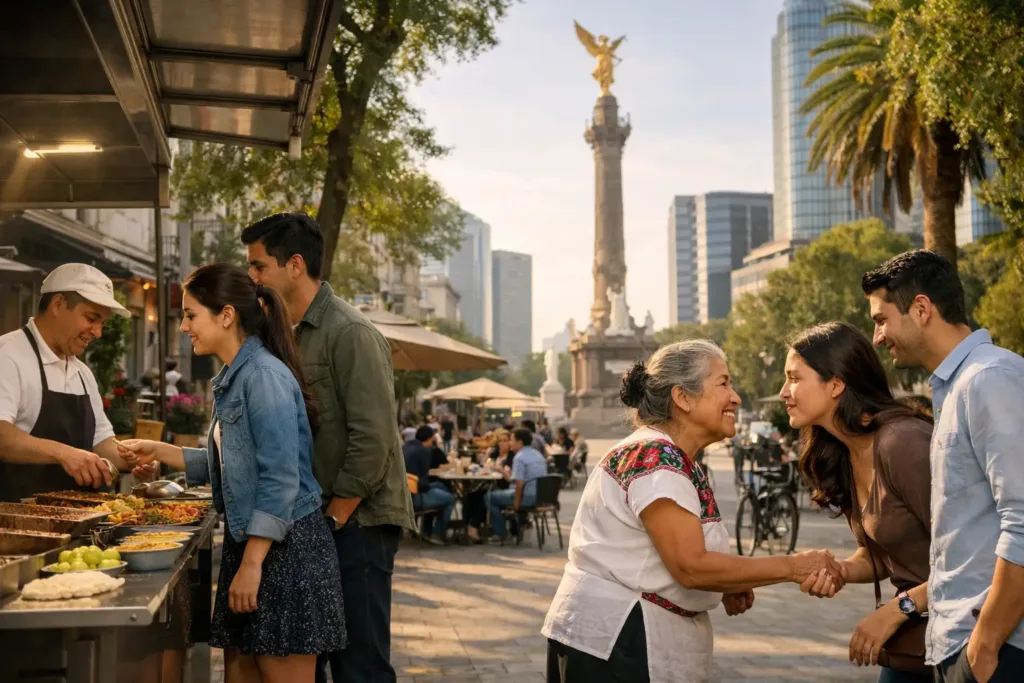
The first small lesson in Mexico City etiquette often happens before you order coffee: say hello. A warm “buenos días,” “buenas tardes,” or “buenas noches” when entering a café, elevator, shop, or reception desk changes the tone of an interaction immediately. This is a vast, fast-moving city, but daily life still runs on recognition, courtesy, and a little patience.
For travelers who want to spend their days beyond the obvious landmarks, etiquette is not a script to memorize. It is a way of moving through the city with attention. Know when to greet, how to tip, why a quick question can matter, and when it is better to slow down and observe the rhythm around you.
Mexico City Etiquette Starts With a Greeting
In many places, getting straight to a request can sound abrupt. Begin with a greeting, then ask for what you need. At a neighborhood bakery, you might say, “Buenos días, ¿me da dos conchas, por favor?” In a restaurant, “Buenas tardes” before asking for a table is an easy, natural gesture.
“Por favor,” “gracias,” and “con permiso” go a long way. Use con permiso when passing closely behind someone, stepping off a crowded sidewalk, or reaching for something nearby. “Disculpe” is useful for getting attention politely, especially with an older person or a service worker.
You do not need polished Spanish to be welcomed. A genuine attempt is appreciated, and many people in Roma, Condesa, Juárez, and central cultural districts speak some English. Still, opening in Spanish signals that you understand you are a guest in someone else’s city. Let the other person guide the language from there.
Let Service Have Its Own Pace
Mexico City has excellent restaurants at every level, from a standing-room taco counter to a long lunch in a beautiful dining room. The pace can vary just as widely. At casual spots, service may be quick and direct. At a more traditional restaurant, it may be relaxed, giving you space to settle in and enjoy the table.
Avoid interpreting a slower pace as inattentiveness. If you need something, make eye contact and say “disculpe” or “cuando pueda.” Asking for the check is expected: “La cuenta, por favor.” It will not always arrive automatically once plates are cleared, because lingering over conversation is part of the meal.
Reservations matter at sought-after restaurants, especially Thursday through Saturday. If you are running late, send a message or call when possible. And if a small fonda has a line, do not assume the crowd is disorganized. Watch for a sign-up list, a host, or the quiet order of regulars who know exactly where they stand.
Tipping Without Overthinking It
Tipping is customary, particularly in restaurants and for personal services. For sit-down meals, 10 to 15 percent is common, with 15 percent a thoughtful standard for very good service. Check the bill before adding a tip, as some groups or special events may already include service.
For coffee, a few pesos or around 10 percent is welcome, especially if someone brings your order to the table. At a bar, tip per round or leave roughly 10 to 15 percent of the final bill. For food delivery, rideshare drivers, salon services, and helpful bag handlers, a modest cash tip is appreciated.
Cash remains useful for these moments, even though cards are widely accepted in many neighborhood restaurants and shops. Carry smaller peso bills. Offering a large bill for a low-cost purchase can create a real problem for a vendor who does not have change, not a personal inconvenience to solve at the counter.
Respect the Sidewalk, the Queue, and the Space
The sidewalk is shared territory in CDMX. Keep to the right when the flow is clear, avoid stopping suddenly at the top of subway stairs, and step aside rather than creating a human roadblock while checking maps. In Roma and Condesa, tree-lined streets make wandering tempting, but residents are moving to work, school, appointments, and home.
Lines can look informal, especially at busy taquerías, market stalls, and street-food stands. Before stepping forward, ask “¿quién es el último?” – who is last? It is one of the most useful phrases in the city. Someone will usually point you to your place in line, and you can wait without guesswork.
Personal space is closer here than it may be in parts of the United States. On the Metro, in elevators, and in crowded markets, a little bumping is unavoidable. A brief “perdón” handles it. What matters is not achieving perfect distance but staying aware of the people around you.
Markets and Street Food Require Curiosity, Not Performance
Markets are places of work first. They are also some of the city’s best places to understand ingredients, regional cooking, and the everyday choreography of neighborhood life. Ask before photographing a vendor, a display, or people eating. A vibrant scene is not automatically an invitation to treat it as a backdrop.
When ordering street food, watch the system before jumping in. Are diners paying first or after? Do people take a number? Is the salsa self-serve? A minute of observation usually answers more than a dozen questions.
It is fine to ask what something is, and vendors are often happy to explain. Keep questions direct and respectful during a rush. If you want to take photos of your meal, do it quickly and make room for the next person. The best street-food experiences feel reciprocal: you receive a memorable meal, and the vendor receives your attention, payment, and respect for their time.
Spice Is Part of the Conversation
Do not assume a dish is mild because it looks familiar. Salsas can range from gentle to genuinely fiery, and the color is not always a reliable clue. Ask “¿pica?” if you want to know whether something is spicy, then begin with a small amount.
There is no prize for proving your tolerance. A careful first taste is smarter than turning a great taco into a regrettable challenge. If you have allergies or dietary restrictions, learn the key words in Spanish and communicate them clearly. “Sin” means without, but it does not always convey the seriousness of an allergy. Explain calmly and ask whether a dish can be prepared safely.
Dress With Context in Mind
Mexico City is creative, design-conscious, and varied. You will see people in tailored workwear, vintage finds, cycling clothes, sharp evening looks, and everything between. There is no need to dress conservatively by default, but context matters.
For museums, galleries, restaurants, and neighborhood walks, comfortable polished layers tend to work well. The city’s weather can turn quickly, and a light jacket is useful even after a warm afternoon. For churches and some traditional communities, choose clothing that feels respectful rather than overly exposed.
Avoid treating local style as costume. The city has a rich visual language, from Indigenous craft traditions to contemporary Mexican design. Enjoy it, support makers when you can, and ask about an object’s origin instead of reducing it to a souvenir aesthetic.
Be Thoughtful With Photos and Public Life
Mexico City is visually generous: tiled facades, flower stands, dancers in public plazas, family-run businesses, and extraordinary street life. Still, people are not scenery. Ask permission before taking close portraits or photographing someone’s stall in a way that centers them.
This is especially important around religious ceremonies, protests, memorials, and Indigenous cultural events. A camera can create distance at moments that call for presence. When in doubt, put the phone away and experience what is happening first.
The same courtesy applies to residential streets. Roma’s handsome architecture and leafy corners are worth appreciating, but keep voices low late at night, do not block doorways for photos, and remember that someone’s front steps are not a set.
Stay Flexible, Calm, and Direct
Plans change in Mexico City. Rain arrives. Traffic builds. A museum closes for an event. A favorite restaurant runs out of the one dish you came for. Frustration rarely improves the outcome, while a calm question often does.
Use a clear, polite tone if something is wrong with a bill, order, or ride. State the issue, ask for help, and leave room for the person to respond. Public confrontation can feel unnecessarily harsh, particularly when a quieter conversation will resolve the problem.
There is also wisdom in accepting a little ambiguity. Not every great meal needs a perfect translation, and not every afternoon needs a fixed itinerary. The city rewards people who arrive prepared but leave space for a recommendation, a detour, or an extra hour at the table.
The most local thing you can do is be a considerate regular, even if you are only here for a few days. Greet the barista twice. Return to the market stall you loved. Learn the name of the person who makes your morning coffee. In a city built from neighborhoods, those small gestures are how a visit begins to feel like a connection.