
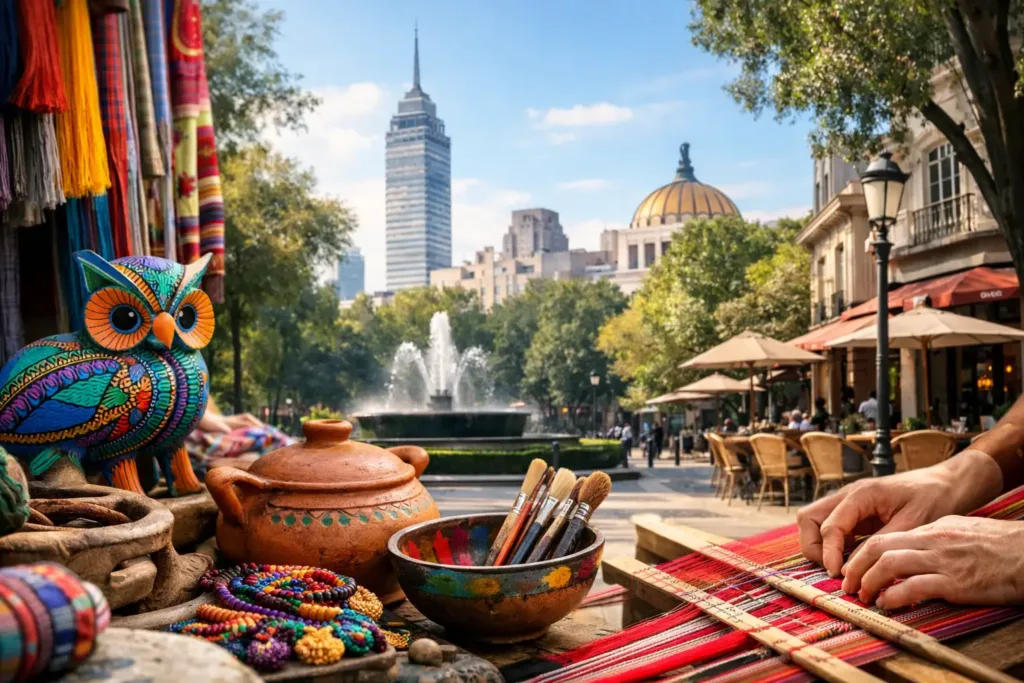
A hand-built cup holds a little more meaning when you remember the clay under your fingernails, the maker’s corrections, and the afternoon light in the studio. That is the appeal of Mexican craft workshops in Mexico City: they turn a beautiful object into a lived memory. For travelers drawn to design, food, and the texture of daily life, a workshop can be a better use of an afternoon than another stop on a checklist.
Mexico City is an especially good place to seek them out. It is a working capital of contemporary design, but its creative energy is deeply connected to traditions from across the country: clay, weaving, papel picado, natural dyes, jewelry, printmaking, and more. The best experiences do not treat those traditions as props. They introduce you to the material, the process, and the people who keep it moving forward.
Why Mexican Craft Workshops Feel Different
A workshop is not simply a class with a souvenir at the end. At its best, it creates a small point of connection between visitor and place. You begin to understand why a certain clay is prized, why a woven pattern takes time, or why a print is built in layers rather than made instantly.
That context matters in Mexico, where many craft practices carry regional histories, family knowledge, and Indigenous roots. A thoughtful instructor will explain where a technique comes from without reducing it to a quick cultural lesson. You may hear about Oaxaca’s long relationship with barro, the role of wool weaving in Teotitlán del Valle, or the graphic legacy of Mexico City’s print studios. The goal is not to leave as an expert. It is to leave with greater attention.
There is also a practical pleasure to making something with your hands while traveling. Remote workers and city-minded visitors spend plenty of time looking at screens, maps, and menus. A few hours spent shaping clay or pulling a screen print offers a welcome change of pace. It asks you to slow down, make imperfect decisions, and be present in a city that can otherwise move quickly.
The Workshops to Look For in Mexico City
The right format depends on what you want from the day. Some sessions are social and accessible, designed for beginners who want to make a small object. Others are more technical, with serious instruction and studio time. Neither is inherently better. The useful question is whether the pace, level of guidance, and finished result match your expectations.
Ceramics and Clay
Ceramics workshops are among the easiest to find, especially around Roma, Condesa, Juárez, and neighborhoods with active design communities. A beginner session may focus on pinching, coiling, or slab-building a cup, small plate, incense holder, or vase. Wheel throwing is often offered separately because it requires more setup and more individual coaching.
Before reserving, ask whether the piece will be fired and how you will receive it. Clay work is rarely ready to carry away the same day. Drying, bisque firing, glazing, and a final firing can take days or weeks. Some studios offer shipping, while others invite you to return later. If your trip is short, a hand-building class with an unfired piece may still be satisfying, but it is worth knowing what you are signing up for.
Textile, Embroidery, and Natural Dye Sessions
Textile workshops offer a more portable result and often make sense for shorter visits. You might learn basic embroidery stitches, work with a small loom, or create a naturally dyed scarf or bandana. These sessions can be especially rewarding when the instructor clearly credits the regional techniques and communities that inform the work.
Natural dyeing has its own quiet magic. Cochineal, indigo, marigold, avocado pits, and other materials reveal color gradually, often with surprising variation. It is less about controlling an exact shade than responding to what the fiber and dye bath produce. Travelers who enjoy process over polish tend to love it.
Printmaking and Paper Arts
Mexico City’s graphic culture makes printmaking a strong choice for design-focused visitors. Linocut, letterpress, risograph, and screen-printing workshops each offer a different kind of satisfaction. Linocut is tactile and direct, while screen printing feels more graphic and layered. A paper-based workshop is also a smart option if you want to take your work home in a tube or folder rather than worry about fragile luggage.
Look for small group sizes. In printmaking, a little one-on-one support can make the difference between feeling lost in the setup and leaving with a print you genuinely want to frame.
Jewelry, Beading, and Metalwork
Jewelry sessions range from relaxed beading classes to more involved silverwork. A simple workshop can be a lovely way to make a personal memento, while metalwork requires patience, safety instruction, and often a longer commitment. If you are choosing a jewelry class because you hope to create something wearable that same day, confirm that the project and finishing process make that possible.
How to Choose a Workshop That Respects the Craft
Mexico City has no shortage of attractive creative experiences, and that is a good thing. Still, a polished social media feed does not tell you everything. Take a few minutes to look at who teaches the class, what they make outside of workshops, and how they describe the technique’s origins.
The strongest hosts are usually practicing makers, small studios, cultural spaces, or collectives with a clear relationship to the work. They explain the materials, acknowledge influences, and avoid exaggerated claims of authenticity. A contemporary ceramicist does not need to present a workshop as an ancient ritual for it to be meaningful. Honest framing is a sign of care.
Language is another consideration. Many workshops are taught in Spanish, while others welcome English-speaking participants or provide bilingual instruction. If you are comfortable with basic Spanish, a Spanish-language class can be a warm way to practice. For technical processes such as metalwork or printmaking, however, clear communication may matter more than language immersion. It depends on how much guidance you want.
Timing deserves attention, too. An evening embroidery session can fit neatly after a day of exploring galleries and restaurants. A dyeing workshop may take most of an afternoon. A multi-session ceramics course asks for a different kind of commitment altogether. Build your plan around the workshop rather than squeezing it between distant neighborhoods.
A Few Good Ways to Prepare
Wear clothes you do not mind marking with clay, dye, or ink, even if the studio supplies aprons. Arrive with a loose idea rather than a perfect design. Beginners often enjoy themselves more when they choose a simple form and let the teacher guide the details.
Bring a tote or flat folder if you are making paper goods, and keep your schedule flexible after any messy session. Most importantly, come curious. Ask about the maker’s own work, where they source materials, and what they are currently experimenting with. Those conversations often become the part you remember.
If you buy work directly from the studio afterward, do so because you love it, not because you feel obligated. Purchasing a maker’s finished pieces can be a meaningful way to support their practice, but a good workshop should never make the class feel like a sales pitch.
Make the Workshop Part of a Neighborhood Day
Creative sessions are most rewarding when they are woven into a day with room to wander. In Roma, for example, you might begin with coffee, spend the afternoon in a studio, then continue with a relaxed dinner nearby. The point is not to race from one cultural activity to the next. It is to give the experience enough space to settle in.
Casa Aimée’s approach to the city begins with that same idea: stay close to the rhythms that make a neighborhood feel lived-in. A workshop can introduce you to a side of Mexico City that is easy to miss from the street – the patient, practical labor behind the objects that fill markets, homes, and design shops.
Leave a little room in your suitcase and a little room in your schedule. The best craft workshop may not produce a flawless object, but it can give you a more lasting way to remember the city: by the weight of the clay, the color on your hands, and the story you can tell when someone asks where it came from.