
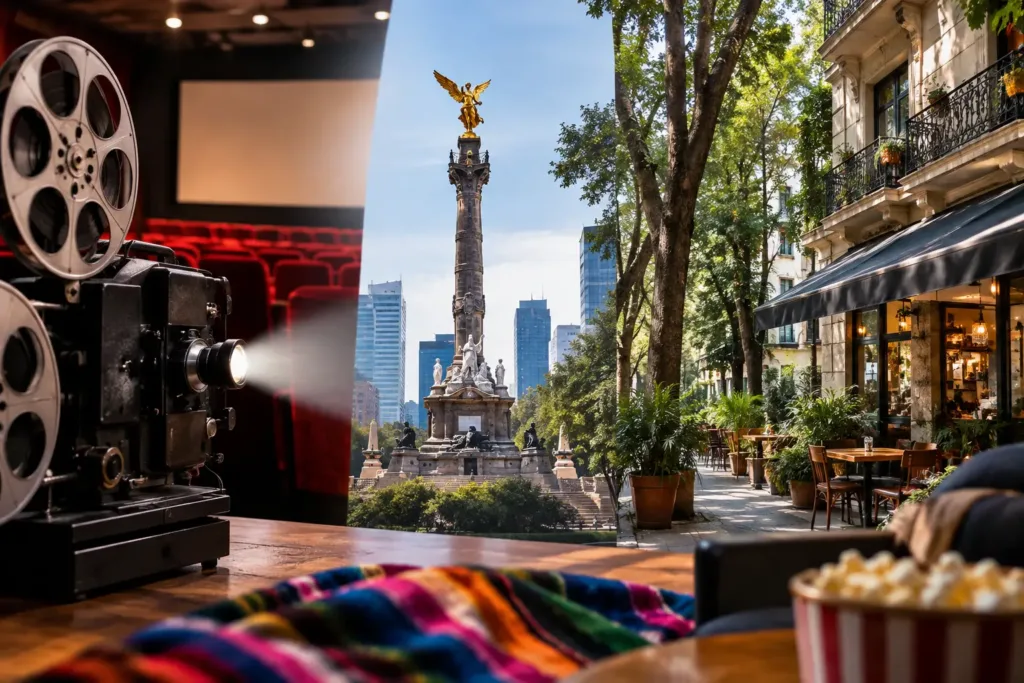
A film night in Mexico City can begin with a coffee in Roma, continue through a tree-lined walk to a neighborhood theater, and end in a long conversation over tacos. Mexican cinema is not confined to one genre, language, or kind of screen here. It is a living part of the city’s cultural rhythm, from landmark theaters showing restored classics to small venues where independent work, documentaries, and international premieres find an attentive crowd.
For travelers who want more than a standard night out, going to the movies is one of the easiest ways to feel the city’s creative pulse. You may not catch every line of rapid Spanish, but the experience still offers a close view of Mexico’s humor, contradictions, family life, visual imagination, and political memory.
Mexican Cinema Has a Long, Restless History
Mexico’s cinematic history reaches far beyond the familiar faces of its Golden Age. During the 1940s and 1950s, performers such as María Félix, Pedro Infante, and Cantinflas became cultural icons across Latin America. Their films moved between melodrama, comedy, ranchera music, and social observation, creating images of Mexico that remain immediately recognizable.
Then came filmmakers who challenged those polished myths. Luis Buñuel made some of his most enduring work in Mexico, including Los Olvidados, a stark portrait of childhood and poverty in the capital. Later generations widened the frame again. Directors including Arturo Ripstein, María Novaro, Guillermo del Toro, Alfonso Cuarón, Alejandro G. Iñárritu, and Amat Escalante have brought Mexican stories to global audiences without making Mexican filmmaking feel like a single export category.
That variety matters when choosing what to watch. A Mexican film might be a quiet character study set in Oaxaca, an unsettling genre piece, a documentary about labor or land, a large-scale historical drama, or an intimate story rooted in a Mexico City neighborhood. The strongest programming lets you see those contrasts side by side.
Where to See Mexican Cinema in Mexico City
Cineteca Nacional for serious filmgoing
The Cineteca Nacional in Xoco is the essential stop for anyone interested in film culture. Its calendar regularly includes Mexican premieres, revivals, director retrospectives, documentaries, festival selections, and international cinema that rarely reaches mainstream multiplexes. It is as much a gathering place as a theater, especially on weekends when people linger in the open-air plaza before or after a screening.
This is a good choice if you are willing to travel beyond Roma and Condesa for a fuller cultural outing. Arrive early, browse the bookshop, and leave enough time to eat nearby or simply sit with the crowd. The schedule changes constantly, so the best approach is to choose a film first and build the evening around it, rather than arriving with a fixed title in mind.
A useful trade-off: the Cineteca offers depth and range, but popular screenings can draw long lines. Weekday afternoons are often calmer than Friday or Saturday evenings. Films may be in Spanish without English subtitles, particularly Mexican releases, so check the screening details if language access will shape your decision.
Cine Tonalá for an easy Roma night
Cine Tonalá feels closer to the pace of a night in Roma. Part cinema, part cultural venue, it has a more intimate atmosphere than a large film complex and often programs independent releases, special events, talks, and music. It is especially appealing when you want the movie to be one part of the evening rather than the whole plan.
The room is small, which can make a good film feel more immediate but also means limited seating. Buy tickets with time to spare for sought-after events. Its location makes it easy to pair a screening with dinner or drinks nearby, though the best nights are often the unplanned ones: a film you had not heard of, followed by a recommendation from someone in the audience.
UNAM venues for a university perspective
The Filmoteca UNAM and cultural spaces at Ciudad Universitaria are worth the trip for travelers drawn to archives, criticism, and more adventurous programming. University screenings often make room for film history, restored prints, socially engaged documentaries, and work from emerging directors that may not play widely elsewhere.
This option is less convenient for a quick evening from central neighborhoods, but that is part of its appeal. Plan it as a half-day outing, perhaps alongside the murals and architecture of the university campus. It gives Mexican cinema context: not just as entertainment, but as an art form studied, preserved, argued over, and kept accessible to new audiences.
Downtown screens for a different city mood
In Centro Histórico, venues such as Casa del Cine offer another way into the city’s film culture. The setting changes the experience. Before the screening, you are in the dense, historic center, surrounded by bookstores, street food, grand facades, and the constant movement of downtown.
Programming and opening hours can shift, particularly at independent cultural spaces, so confirm the day’s schedule before making the trip. Still, a downtown screening is ideal for visitors who want an evening that feels distinctly Mexico City: layered, energetic, and a little less predictable than a conventional movie date.
What to Watch Beyond the Famous Directors
If you only have time for one Mexican film, choose based on mood rather than reputation. For Mexico City itself, Cuarón’s Roma offers a carefully observed look at the city in the early 1970s, while Fernando Eimbcke’s Temporada de Patos captures a smaller, more contemporary urban intimacy. Alonso Ruizpalacios’s Güeros is playful, restless, and deeply tied to the capital’s student culture and geography.
For a sharper political edge, documentaries can be especially rewarding. Mexico has a vital nonfiction tradition that addresses disappearances, migration, Indigenous communities, environmental conflict, journalism, and daily life with unusual proximity. These films can be emotionally demanding, but they also provide perspectives that travel guides cannot offer.
Do not overlook genre cinema, either. Guillermo del Toro’s international reputation has helped broaden interest in Mexican fantasy and horror, but the local scene is far wider than one director. Festivals such as Macabro and Mórbido regularly show how Mexican filmmakers use horror, science fiction, and dark comedy to speak about class, violence, faith, and family.
Festivals Make the City Feel Like a Film Set
Mexico City’s calendar has several moments when cinema spills beyond theater walls. FICUNAM brings adventurous international and Mexican work to university and cultural venues. Ambulante, known for documentary, creates conversations around films through screenings and public events. DocsMX and genre-focused festivals add their own audiences and energy.
Festival dates, venues, and ticket systems vary from year to year, so flexibility helps. If your visit overlaps with one, do not try to see everything. Pick one film that genuinely interests you, arrive early, and stay for the discussion if there is one. Q&As are often in Spanish, yet even partial understanding can be worthwhile because the room’s questions reveal what the film means locally.
A Few Practical Notes for Your Film Night
Most independent theaters sell tickets at the box office and through their own platforms. For a spontaneous evening, have a second choice in mind, especially on weekends. In many theaters, seats are not assigned, so arriving 20 to 30 minutes early is sensible.
Subtitles work differently than visitors may expect. International films are commonly shown in their original language with Spanish subtitles. Mexican films are often shown in Spanish without English captions. If your Spanish is limited, choose a visual film, a documentary with a subject you already know, or an international title at a local venue. You will still get the pleasure of the room, the architecture, and the audience response.
Keep the experience simple: put your phone away, respect the quiet of smaller rooms, and resist the urge to rush out at the credits. Mexican audiences often stay through them, particularly at festivals and repertory screenings. That final minute can tell you whether applause, debate, or silence is coming next.
A good film can change how you walk through the city afterward. You may notice a bus route, a courtyard, a family table, or the evening light on a Roma street with a little more attention. Let that be the point: choose a screening that interests you, leave room for a late meal, and allow Mexico City to keep unfolding after the lights come up.