
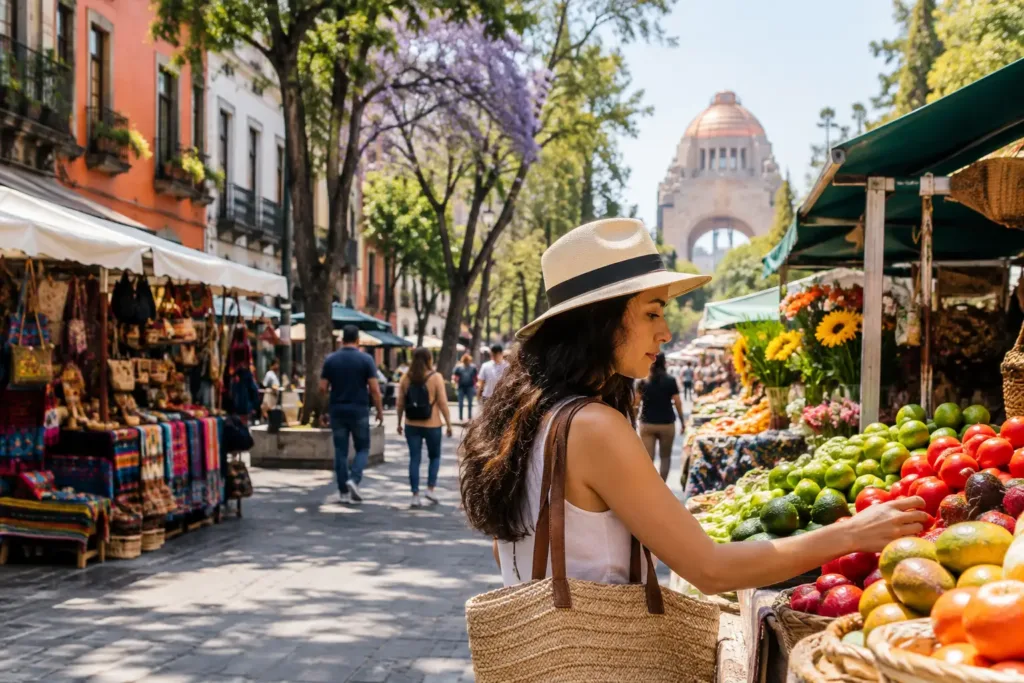
The best way to understand Mexico City is often with a reusable bag in hand, standing between a fruit stand and a stall selling fresh tortillas. If you are wondering how to find local markets in a city this large, skip the idea that there is one “best” market. The real pleasure is finding the market that fits the neighborhood, the day of the week, and your appetite.
A morning market visit can be a practical errand, a breakfast plan, and a small lesson in city life all at once. In Roma, Condesa, and beyond, mercados and tianguis reveal the rhythms that polished restaurant lists cannot always show: who is shopping, what is in season, which salsas people are taking home, and where the line forms before lunch.
Start by knowing the kind of market you are looking for
In Mexico City, the word mercado can describe a permanent covered market with fixed stalls, while a tianguis is a street market that appears on certain days. Both are worth seeking out, but they offer different experiences.
A neighborhood mercado is where people buy the ingredients for daily cooking. You will find produce, butcher counters, flower sellers, dry chiles, kitchen tools, prepared foods, and small stands that have served regulars for years. These markets are usually open most days, generally from morning into the afternoon. They are an easy choice when you want a focused, low-planning visit.
A tianguis has more movement and surprise. Streets fill with canopies, vendors set up early, and the mix can range from avocados and herbs to socks, vinyl records, household goods, and ready-to-eat snacks. Some tianguis are food-forward; others are more useful for people-watching and the occasional unexpected find. Since schedules vary by neighborhood, timing matters more here.
Then there are destination markets. Mercado de Jamaica is known for flowers, plants, and color at a grand scale. Mercado de San Juan is a fascinating stop for specialty ingredients, cheeses, meats, and products that appeal to serious cooks. La Lagunilla, especially on Sundays, blends antiques, vintage clothing, street food, and a distinctly social weekend energy. These are memorable visits, though they can feel busier and more performative than the market closest to someone’s home.
How to find local markets near where you are staying
Begin with the ordinary question a local would ask: where do people buy dinner around here? Search maps for “mercado” rather than only “food market,” then look beyond the highest-rated results. A place with a modest online presence, a practical name, and photos of produce or prepared-food counters is often exactly what you want.
For a neighborhood base in Roma, Mercado Medellín is a natural starting point. It is lively, approachable, and particularly good for seeing the city’s broader Latin American food culture alongside everyday Mexican staples. Mercado de Coyoacán makes sense when you are spending a day in the south, while Mercado de Jamaica rewards an early visit if flowers, photography, or cooking are part of your itinerary.
To find a tianguis, ask a barista, a restaurant server, a gallery attendant, or the person at your building’s front desk what sets up nearby and on which day. Be specific: ask where they personally shop for fruit, flowers, or a weekday lunch. That small adjustment tends to produce better answers than asking for a “hidden gem.” People may point you to a street you would never have searched on your own.
Neighborhood social feeds and community bulletin boards can also help, particularly for weekend markets and seasonal pop-ups. Still, treat online schedules as a lead, not a promise. A tianguis may shift blocks, end earlier in bad weather, or have a different scale during holidays. If a market matters to your plans, go in the morning and leave room for a second option nearby.
Follow the clues on the street
The city gives you signals. Look for metal shutters opening early, delivery carts stacked with crates, handwritten signs advertising comida corrida, or a cluster of people carrying flowers and produce. In residential areas, the smell of grilled corn or simmering stock can be more useful than a map pin.
Markets are not always dressed for visitors. A great local one may have a plain exterior and fluorescent lighting. Step inside anyway. The most inviting details are usually small: a juice counter with regulars, a tortillería pressing warm tortillas, or a lunch stall where neighboring vendors are eating.
Go at the right hour, not just the right address
Morning is the best time for produce, flowers, and a calmer pace. Arrive between 9:00 and 11:00 a.m. if you want to browse before lunch crowds build. This is also when vendors have more space to chat, especially if you are buying something rather than only taking photos.
Late morning through early afternoon is ideal for market food. The busiest stalls are often a good sign, but pay attention to how quickly food moves and whether it is being cooked to order. A line of local customers is more meaningful than a dramatic sign or a social-media-famous dish.
By mid-afternoon, many permanent markets begin to wind down. Tianguis can be even less predictable, with some vendors packing up earlier than expected. If you are shopping for ingredients to cook, do not save the visit for the final hour. If you are simply looking for a plate of tacos, a bowl of pozole, or a fresh juice, lunchtime is usually your moment.
Eat with curiosity and a little patience
Market food is one of the city’s great pleasures because it is direct. You are eating recipes made for people with places to be, not a staged version of Mexican food. Start with something simple: a quesadilla made on a comal, a taco de guisado, chilaquiles, a torta, or a glass of freshly blended juice. Watch what people at the counter are ordering and use that as your menu.
If you are unsure how to order, a friendly “¿Qué me recomienda?” goes a long way. You can also point, ask for one serving, and take a seat if there is space. At a busy stall, be ready to order when your turn comes. It keeps the line moving and shows consideration for the people grabbing lunch on a workday.
A few practical habits make the experience easier. Carry small bills and coins, because not every stall accepts cards. Bring hand sanitizer and a tote bag. Ask before photographing a vendor or a display, particularly in smaller family-run stalls. Most people are welcoming, but a market is a workplace first.
Use the same good judgment you would use anywhere: choose busy food stands with active cooking, notice whether hot food is served hot, and ease into raw items if your stomach is still adjusting to travel. The goal is not to be overly cautious. It is to eat well enough to keep exploring.
Let the market shape the rest of your day
The most satisfying market visits are rarely isolated stops. Buy fruit and pan dulce for a slow morning at home. Pick up flowers before an afternoon of gallery-hopping. Have breakfast at a counter, then walk through the surrounding streets without trying to optimize every block.
This is where markets become more than a checklist of regional dishes. They offer an honest sense of the neighborhood’s pace. In one aisle, someone is buying ingredients for lunch; in another, a vendor is discussing the price of limes with a regular; nearby, a cook is stirring a pot that will sell out by 2:00 p.m. You are not outside the city looking in. You are briefly moving with it.
Casa Aimée guests often find that the most useful local recommendations are not the most obvious ones. A favorite market may be five blocks away, open only on Tuesdays, and memorable because of one breakfast counter or one flower stall rather than a famous name. Leave space for those discoveries.
Choose local over “Instagrammable” when it counts
Some markets are built for browsing, and some are built for daily life. Neither is wrong, but they serve different moods. A design-forward food hall can be enjoyable for a group with varied tastes, while a traditional mercado may offer more texture, better prices, and a clearer connection to neighborhood life. It depends on whether you want a polished outing or an everyday experience.
If you only have time for one market, choose the one near the area where you are already spending the day. You will see more when the visit has a purpose, even if that purpose is simply finding breakfast. Instead of crossing the city for a name you saw online, follow the smell of tortillas, order what looks good, and let the neighborhood introduce itself.