
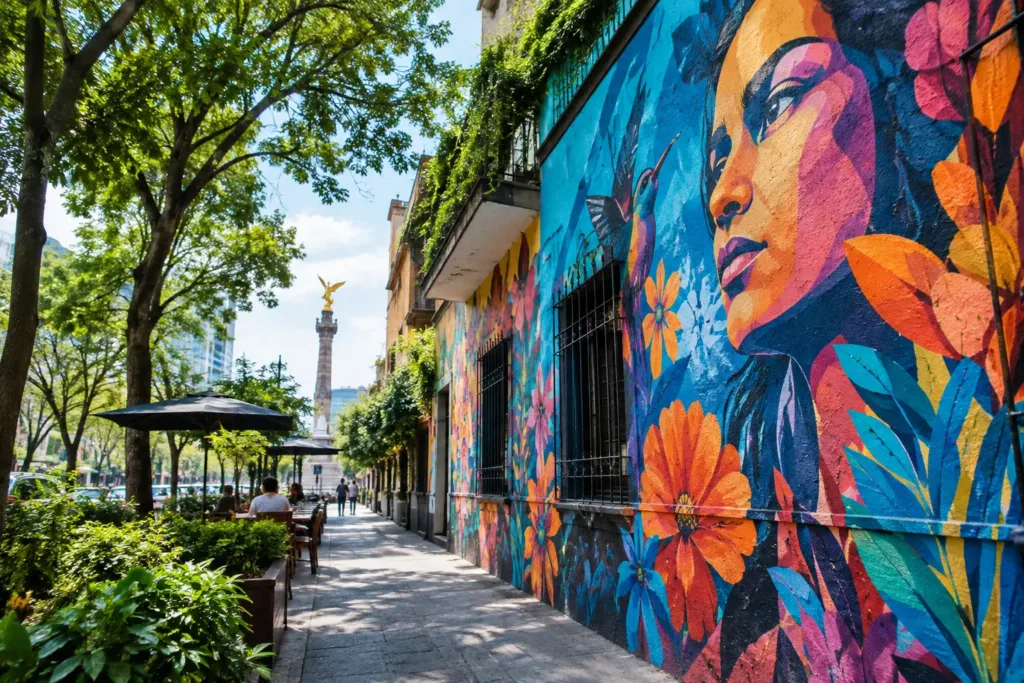
Mexico City’s best street art rarely announces itself. It appears beside a tire shop, across the shutters of a family-run business, at the end of a tree-lined Roma street, or on a long concrete wall you might have missed while looking for lunch. This guide to CDMX street art is less about checking off famous murals and more about learning how to walk slowly enough to notice what the city is saying.
Street art here is not a single style or a fixed outdoor museum. It can be political, playful, memorial, abstract, deeply local, or made simply to transform a blank wall. Some pieces last years; others are painted over in a month. That changing quality is part of the experience.
Start in Roma Norte and Roma Sur
Roma is a natural starting point because the art is woven into an easy day of cafés, galleries, bookstores, and long walks. The neighborhood’s low-rise streets create a human-scale canvas: garage doors, corner stores, construction barriers, and side walls all become opportunities for color.
In Roma Norte, walk without a rigid route around Avenida Álvaro Obregón, Colima, Orizaba, and the quieter streets that branch away from the busiest restaurant blocks. Look up as often as you look ahead. Larger murals often occupy upper façades, while smaller paste-ups, stencils, and hand-painted signs sit near eye level.
Roma Sur feels more residential and a little less performative. The walls here can reward a slower pace, especially around Mercado Medellín and the streets leading south toward Viaducto. You may find less of the polished mural-tour feeling and more evidence of a neighborhood in motion: tags layered over older paint, small interventions on utility boxes, and storefront art made for the people who pass every day.
The trade-off is simple. Roma is convenient and visually rich, but it is also popular. If you want photographs with fewer people and softer light, go early in the morning. If you prefer to see the neighborhood at its most social, walk in the late afternoon, then pause for a drink or dinner nearby.
Condesa and Juárez: Design, color, and detours
Condesa’s art scene is often subtler than Roma’s, but its streets are worth including in any guide to CDMX street art. The neighborhood’s Art Deco buildings, mature trees, and rounded corners create a striking backdrop for contemporary pieces. Wander around Parque México and Parque España, then continue along side streets rather than staying on the main avenues.
Here, notice the conversation between architecture and paint. A bold geometric mural can feel entirely different against a faded 1930s façade than it does on a warehouse wall. Condesa also has a strong graphic-design sensibility, so keep an eye out for typography, illustrated signage, and window displays as well as murals.
Juárez offers a more varied visual rhythm. It sits between polished galleries, historic buildings, busy avenues, and streets that still feel a bit rough around the edges. Around Calle Havre, Liverpool, and the blocks near Reforma, you may see large-scale work alongside older walls marked by years of layering. This is a good area to walk when you want street art as part of a broader city texture, not as a separate attraction.
Go south of the postcard route in Doctores
Doctores is often mentioned by people looking for a grittier, more expansive side of Mexico City’s urban art. It has working garages, auto-parts shops, busy streets, and industrial-scale surfaces that invite bolder work. The neighborhood is not a place to rush through with your phone held out. Visit during daylight, stay aware of your surroundings, and choose a route with purpose.
What makes Doctores compelling is the scale and directness. Walls can carry social commentary, tributes, surreal characters, and lettering that speaks to the traditions of graffiti and muralism rather than to a visitor’s camera. It is a place where the distinction between sanctioned mural, graffiti, and neighborhood expression can feel less tidy – and that is precisely the point.
If you are new to the city or walking alone, it may be more comfortable to explore the edges of Doctores from Roma or the Centro Histórico rather than trying to cover the whole neighborhood. Mexico City rewards confidence, but good judgment is part of traveling well.
Centro Histórico: Look beyond the landmark façades
The Centro Histórico is best known for its monumental architecture, but its side streets tell a more immediate story. Away from the Zócalo and major pedestrian corridors, street art appears on metal shutters, alleys, walls near workshops, and temporary construction surfaces.
This is where context matters most. The center carries layers of pre-Hispanic, colonial, labor, commercial, and political history. A mural may reference Indigenous identity, migration, feminism, popular culture, or a current local issue. You do not need to decode every image, but taking a moment to observe recurring symbols makes the walk more rewarding.
Try arriving in the morning, before the streets reach full volume. Begin near Alameda Central, drift through the blocks around Barrio Chino and San Juan, then continue toward the older commercial streets. Keep your belongings close in crowded areas, and resist the urge to step into traffic for the perfect angle. The wall will still be there from the sidewalk.
How to read the walls, not just photograph them
The most memorable street-art walks are not built around a map pin. They are built around attention. Before taking a photo, look for the clues around a piece: Is it on an open wall or a business shutter? Has it been commissioned? Is it newly painted over an older work? Does it echo the color of the building, the neighborhood’s history, or a political moment?
Mexico City has a long mural tradition, and contemporary street art exists in conversation with it. But the city also has active graffiti cultures with their own rules, visual languages, and rivalries. Not every mark is meant to be legible to everyone, and not every wall is made for a visitor’s approval. That is a useful thing to remember.
Photograph generously, but respectfully. Avoid blocking doorways, photographing people without consent, or treating someone’s workplace as a backdrop. If an artist is actively painting, a quick greeting and a simple question can go further than assuming access. Sometimes the best response is to watch quietly and let the work remain part of its neighborhood.
Build a street-art walk around the rest of your day
A good CDMX street-art route leaves room for detours. Plan one or two anchor points, then let the streets fill in the rest. In Roma, pair a morning walk with coffee and a market stop. In Condesa, take your time around the parks and continue toward Juárez. In the center, combine walls with museums, historic buildings, and a long lunch.
Avoid trying to cover every neighborhood in one day. The distance on a map can be misleading, and Mexico City’s traffic, weather, and sheer visual density make a slower plan more satisfying. Two focused neighborhoods are usually enough for an afternoon.
Bring water, comfortable shoes, and a charged phone, but do not rely entirely on it. The piece you came to find may be gone, while something better appears around the next corner. That is not a failed itinerary. It is the city doing what it does best: changing the view just as you learn how to see it.