
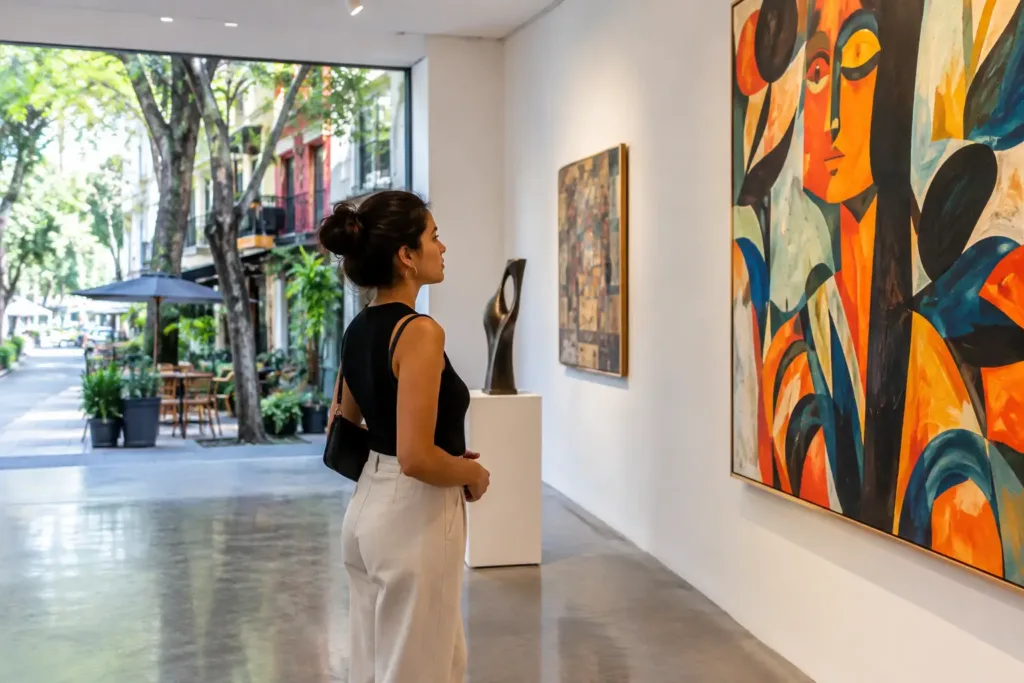
Roma’s art scene is best experienced between coffee, a long walk, and an unplanned conversation with a gallery attendant. If you are searching for the best art galleries Roma has to offer, skip the idea of a rigid museum-style itinerary. This neighborhood rewards curiosity: a polished exhibition on Colima can sit a few blocks from an experimental project space, a historic house, or a bookstore where the art conversation continues.
Roma Norte in particular has become one of Mexico City’s most compelling places to see contemporary art. The galleries here are not simply stops to check off. They are part of the neighborhood’s daily rhythm, shaped by its architecture, international creative energy, and deep connection to Mexican artists and ideas.
What makes Roma’s gallery scene worth your time
Mexico City’s major museums deserve their own day, but galleries offer something more immediate. You may encounter a single artist’s new body of work, a focused group show, or a piece still being discussed by collectors, curators, and the people who made it. The scale is more intimate, and the experience is often less formal.
Roma also makes gallery-hopping unusually easy. Several leading spaces are within walking distance of one another, especially around Colima, Córdoba, and the streets just east of Plaza Río de Janeiro. Still, this is not a neighborhood where more is automatically better. Two or three thoughtful visits, followed by lunch or a slow drink nearby, usually feel more rewarding than racing through every open door.
Most galleries are free to enter, but exhibition dates and hours can shift. Some close between shows, while others keep limited weekday or Saturday schedules. Check before heading out, especially if you are building your day around one specific exhibition.
The best art galleries in Roma, CDMX
OMR
OMR is one of the city’s defining contemporary galleries and an essential stop for anyone interested in Mexico City’s place in the global art world. Its program brings together established and emerging artists from Mexico and beyond, often with exhibitions that are visually striking but never merely decorative.
The gallery’s home, a converted industrial building on Córdoba, is part of the appeal. There is a sense of arrival when you step off the street and into its spacious, carefully considered rooms. Give yourself time here. Even when a show feels minimal at first glance, the details tend to reveal themselves slowly.
Proyectos Monclova
On Colima, Proyectos Monclova presents contemporary work with a sharp, research-driven perspective. The gallery is known for representing artists whose practices move across painting, sculpture, photography, installation, and conceptual work, making it a strong choice for visitors who want to see what is shaping current conversations in Mexican art.
Its exhibitions often ask for a little attention rather than offering instant spectacle. That is precisely the point. Come in without needing to understand everything immediately, read the exhibition text if available, and let the work set the pace.
Galería Hilario Galguera
Galería Hilario Galguera has a long-standing reputation for ambitious contemporary programming. The space has shown major international figures alongside artists from Mexico and Latin America, so the calendar can feel expansive in both scale and outlook.
This is a good gallery to visit when you want something with presence: large works, strong visual ideas, and exhibitions that often carry a clear curatorial point of view. It is also conveniently placed for an afternoon along Colima, where several galleries can be combined without turning the day into a logistical project.
Karen Huber Gallery
Karen Huber Gallery is a thoughtful stop for discovering artists working across generations and mediums. Its program often has a distinct sensitivity to drawing, material, color, and narrative, with exhibitions that can feel personal even when they address larger social or cultural questions.
The space is especially rewarding for travelers who enjoy noticing the smaller decisions in an exhibition: how a work is framed, how objects relate across a room, or how an artist uses repetition and texture. It may not always be the loudest show on the block, but it is frequently one of the most memorable.
MAIA Contemporary
MAIA Contemporary brings a fresh, internationally minded presence to Roma’s gallery circuit. Its exhibitions tend to foreground emerging and mid-career artists, often presenting work that feels current without chasing novelty for its own sake.
For creative professionals visiting Mexico City, this is a useful place to see how younger artistic practices are being presented in the city right now. Expect a setting that feels considered and welcoming, with enough room to look closely rather than simply pass through.
Galería Machete
Galería Machete has long been associated with an energetic, artist-centered approach to contemporary art. The program can be playful, challenging, political, or all three at once, and it offers a welcome counterpoint to the more pristine white-cube experience.
Visit with an open mind. The work here may be less interested in easy visual harmony and more interested in friction, humor, or a new way of seeing familiar materials. That makes it a particularly good stop if you have already seen more polished commercial exhibitions and want something with a different pulse.
How to plan a gallery afternoon in Roma
Start around late morning or early afternoon, when the neighborhood is awake but not yet at its busiest. Begin on Colima, where you can visit Proyectos Monclova, Galería Hilario Galguera, Karen Huber Gallery, and MAIA Contemporary depending on what is open. From there, continue toward Córdoba for OMR, allowing yourself time to wander rather than following a strict route.
The most satisfying gallery days leave room for pauses. Roma is full of handsome facades, leafy side streets, independent shops, and cafés that invite you to sit with what you have just seen. A show may lead you into a conversation about contemporary Mexico, architecture, politics, craft, or color. Let that conversation continue over a meal instead of immediately reaching for the next destination.
If you only have time for two spaces, choose based on the exhibitions rather than reputation alone. OMR and Proyectos Monclova make a strong introduction to the city’s established contemporary scene. Karen Huber and MAIA Contemporary can be especially appealing when you want a more intimate, emerging, or materially focused perspective. There is no wrong pairing, and the changing programs are part of the pleasure.
A few gallery etiquette notes that make a difference
Gallery staff are there to welcome visitors, not to make the space feel intimidating. A simple greeting in Spanish goes a long way: “Hola, buenas tardes.” If an exhibition text is available, take a moment with it. If you are curious about an artist or a work, asking a respectful question is completely appropriate.
Photography policies vary, so look for signs or ask before taking pictures. Avoid touching works, even when a sculpture appears informal or inviting. And if you enter with a coffee or a large bag, be prepared to keep it close or leave it where requested.
For visitors who are new to contemporary art, the easiest way to look is to stay with one piece longer than feels necessary. Notice its materials, title, scale, and what it asks you to feel or question. You do not need specialized vocabulary to have a real response. Curiosity is enough.
See Roma beyond the exhibition rooms
Art in Roma does not end at the gallery door. The neighborhood’s visual culture lives in its early 20th-century homes, street posters, floral storefronts, design studios, bookshops, and public life. A gallery afternoon is one way to enter that world, not a separate activity from it.
Casa Aimée guests often find that the best plan is simply to choose one exhibition that genuinely interests them, walk there, and let the neighborhood fill in the rest. Leave a little time unplanned. In Roma, the work you remember most may be the piece you expected to see – or the one you found because you took the longer way home.