
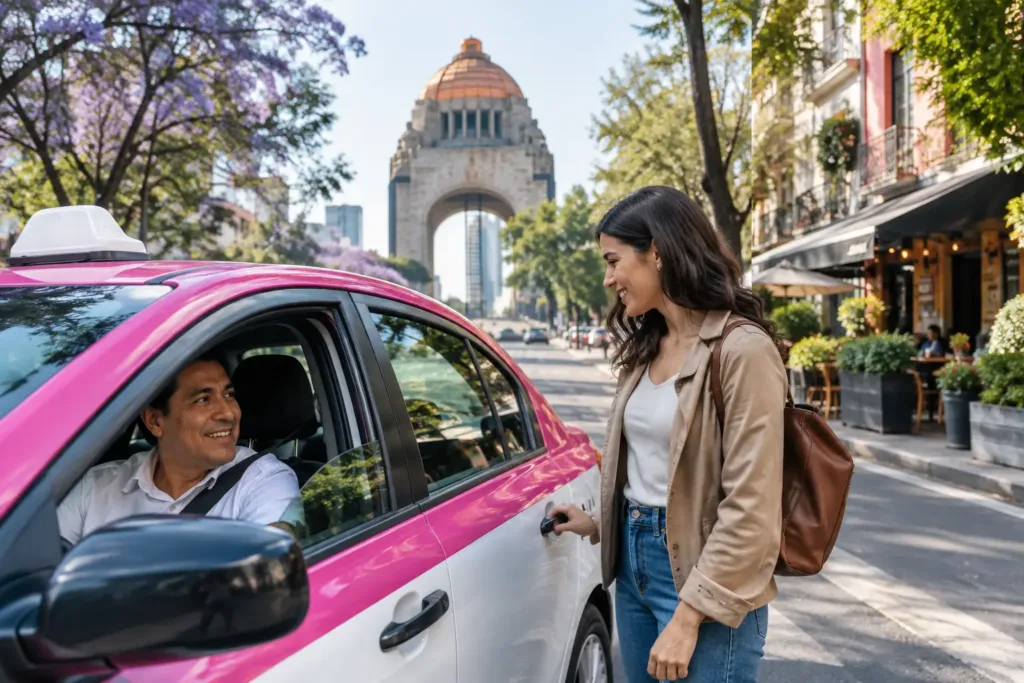
Mexico City can feel enormous from the back seat of a car: leafy Roma streets give way to grand avenues, then suddenly you are crossing town for tacos, a gallery opening, or a late dinner in Coyoacán. So, are Mexico City taxis safe? Yes, when you choose the right kind of ride and use the same street awareness you would in any major city.
The short version is simple: app-based rides and authorized taxi services are the easy choice for most visitors. Hailing an unmarked or random street taxi is where the risk and uncertainty rise, particularly at night or in less familiar areas. A little discernment lets you move through CDMX comfortably, without treating the city as something to fear.
Are Mexico City Taxis Safe for Visitors?
Mexico City taxis are not all the same. The city has millions of daily trips, and most happen without incident. But the traditional pink-and-white street taxis have a mixed reputation because visitors may encounter issues such as a driver declining to use the meter, taking an unnecessarily long route, or, less commonly, theft and scams.
That does not mean every street taxi is unsafe. Many residents use them every day, especially from established taxi stands known as sitios. The practical distinction is whether you can verify the vehicle and driver before getting in. With an app ride, you see the driver’s name, photo, license plate, route, and fare estimate. That traceability changes the experience.
For travelers, remote workers, and anyone still learning the rhythm of the city, it is worth choosing convenience over a slightly lower fare. It buys peace of mind and keeps your energy for the good stuff: the bakery around the corner, a long lunch in Roma Norte, or an evening wandering through La Condesa’s parks.
The Best Ways to Get Around by Car
Ride-hailing apps are widely used in Mexico City and are generally the most dependable option. Uber is familiar to many international visitors, while DiDi and Cabify are also commonly available. Availability and pricing vary by neighborhood and time of day, so having more than one app downloaded can be useful.
Before getting in, check that the car’s license plate, model, and driver match the details in the app. Ask the driver to confirm your name rather than volunteering it first. Sit in the back seat when traveling alone, share your trip status with someone you trust if it makes you feel more comfortable, and follow the route on your own map app. These are low-effort habits, not signs that something is likely to go wrong.
Authorized sitio taxis are another solid option. You will find them outside major museums, restaurants, transit hubs, hospitals, and event venues. Rather than flagging down a passing cab, ask a restaurant host, gallery staff member, or door attendant to call a sitio taxi. They work with local drivers they know, which adds a layer of accountability.
At Mexico City International Airport, use only the authorized taxi counters or approved ride-hailing pickup procedures. Do not accept a ride from someone approaching you inside the terminal, no matter how helpful they sound. For authorized taxis, you pay at the official counter, receive a ticket, and are directed to the correct vehicle. It is structured, straightforward, and preferable after a flight.
When the Metro or Metrobús Makes More Sense
A car is not always the fastest option. Mexico City traffic can turn a short afternoon trip into a long one, especially on weekday mornings and late afternoons. For daylight travel along major corridors, the Metro and Metrobús can be efficient, inexpensive, and full of everyday city life.
That said, crowded transit requires attention to your belongings. Keep your phone and wallet out of back pockets, wear bags in front of you, and avoid displaying valuables near doors. If you are arriving late, carrying luggage, or heading somewhere unfamiliar, an app ride is usually the more relaxed choice.
Times and Places to Be More Selective
The question is less about whether taxis are universally safe and more about context. In Roma, Condesa, Juárez, Polanco, Coyoacán, and many well-trafficked central neighborhoods, app rides are an ordinary part of the evening. Still, nighttime is when you should be most intentional. Request your ride from inside a restaurant, bar, or building lobby, then wait until the car arrives before stepping onto the street.
After a concert, soccer match, or major event, rides can be harder to find and surge pricing can be steep. It may be tempting to take the first unofficial offer you hear. Resist that pressure. Walk to a brighter, busier pickup point, wait a few minutes for an app ride, or ask venue staff where to find an authorized taxi stand.
Be similarly careful in areas you do not know well, especially if you are far from central neighborhoods after dark. Mexico City is a patchwork of distinct communities, not one uniform experience. Local advice matters. A bartender or shop owner can often tell you whether the next few blocks are easy to walk or whether calling a car is wiser.
Small Habits That Make a Big Difference
Most taxi safety is about reducing unnecessary friction. Enter your destination in the app before the car arrives so there is no confusion about where you are going. Make sure your phone has enough battery for the trip, and keep a portable charger if you expect a long day out.
If you use an app ride, paying in-app avoids the need to discuss cash or change. If you take a sitio or street taxi, carry small bills and agree on the fare before departing if the meter is not in use. In Mexico City, it is reasonable to politely ask, “¿Usa taxímetro?” meaning, “Do you use the meter?” If the answer feels evasive, choose another car.
A few details deserve particular caution:
- Do not get into a taxi that already has another passenger unless it is clearly part of an organized shared service.
- Do not let an unfamiliar driver handle your phone, wallet, or luggage without keeping an eye on it.
- Do not use unofficial taxi solicitations at airports, bus terminals, or tourist-heavy areas.
- Do not assume a car is your only option when traffic, crowds, or a well-lit walk make another choice more pleasant.
None of this requires speaking fluent Spanish. A calm “No, gracias” goes a long way. You can also save your destination, home base, and a few favorite spots in your map app before leaving for the day, which makes communication easier when service is patchy or you are tired.
What to Do if a Ride Feels Off
Trust the feeling early. If the vehicle does not match the app, cancel before getting in. If a driver asks you to cancel the app trip and pay directly, decline and end the ride. If a route feels strange, check your map, ask a simple question, and request to be let out in a public, well-lit place if needed.
For an app ride, use the in-app safety tools to contact support or report a concern. In an emergency, call 911 in Mexico. Keep the vehicle details or a screenshot of the trip if you need to make a report later.
It is also helpful to separate inconvenience from danger. A driver missing a turn, taking a slower route because of traffic, or being quiet is not automatically a red flag. But pressure to change payment methods, a mismatch between car and app, unwanted detours, or a driver refusing to stop are reasons to act promptly.
A More Relaxed Way to Experience the City
The goal is not to spend your visit watching over your shoulder. Mexico City rewards curiosity: morning coffee on a tree-lined corner, an unplanned stop at a design shop, dinner that stretches well past midnight. Choosing verified transportation simply gives that curiosity a safer container.
Use app rides for late nights and cross-city trips, request a sitio taxi when a trusted local business can call one, and leave random street hails for situations where you know the neighborhood and feel fully comfortable. Once those habits become routine, getting around feels less like a logistical puzzle and more like part of the city’s daily rhythm.