
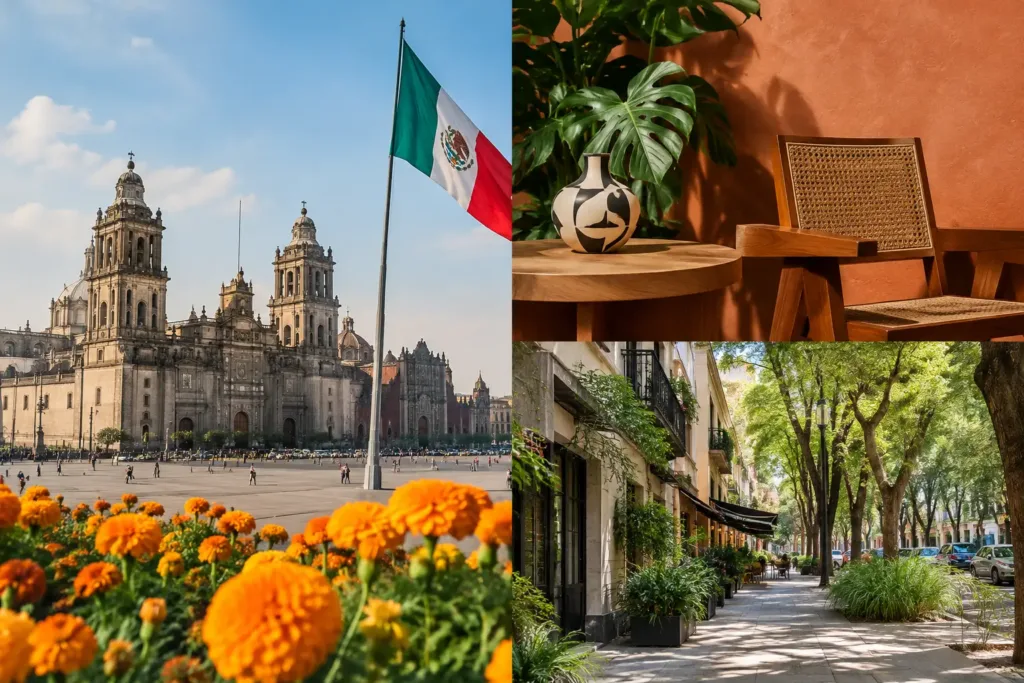
A cobalt-blue doorway in Roma, a hand-painted sign above a neighborhood fonda, the cool geometry of volcanic stone underfoot – Mexican design is easiest to understand when you encounter it between plans. It is not confined to a museum label or a souvenir shelf. In Mexico City, design is part of the daily rhythm: a tiled courtyard catching afternoon light, a flower seller arranging color with instinctive precision, a century-old façade beside a sharply contemporary gallery.
For travelers drawn to places with a point of view, the city offers a richer lesson than the familiar visual shorthand of bright colors and folk motifs. Those elements matter, but they are only part of the story. Mexican design is layered by region, history, material, and the people who continue to make, adapt, and live with it.
Mexican Design Is Not One Look
The temptation is to reduce Mexican design to a mood: saturated pink, woven textiles, Talavera tile, sun-washed plaster. These references can be joyful and real, but they become shallow when separated from their origins. A textile pattern may carry the knowledge of a particular Indigenous community. A ceramic technique may have traveled through centuries of trade, migration, and family workshops. A seemingly simple chair may sit at the intersection of modernist ideals and local craftsmanship.
Mexico City makes those overlapping influences visible. Pre-Hispanic material traditions, Spanish colonial architecture, European modernism, Art Deco, and contemporary experimentation all share the same urban frame. The result is not a single national aesthetic. It is a living conversation, sometimes harmonious and sometimes full of tension.
That tension is worth noticing. Design can celebrate craft while also turning it into a luxury object. It can preserve historic buildings while raising the cost of life around them. Looking closely means appreciating beauty without treating the city as a backdrop. The most meaningful encounters happen when curiosity comes with context.
Start With the City’s Materials
Mexico City has a material language that feels immediate. You see it in tezontle, the porous red volcanic stone used on historic buildings; in dark basalt; in cantera stone; and in glazed tile that shifts character from one block to the next. These materials do more than decorate. They hold temperature, light, memory, and a relationship to the landscape beneath the city.
In the historic center, look upward at the façades rather than only at street level. Ornamental ironwork, carved stone, tiled details, and formal balconies reveal how much visual drama can live in a functional building. The area rewards a slow walk, especially in the morning before the sidewalks become crowded.
In Roma and Condesa, the story changes. Early 20th-century homes move between French-influenced details, Art Nouveau curves, and Art Deco geometry. Rounded corners, patterned floors, stained glass, and small garden setbacks give these streets their particular cadence. Some buildings have been carefully restored; others show their age in peeling paint and repaired stucco. Both can be beautiful. Design here is not always pristine, and it should not have to be.
Modernism Gave Mexico City a New Vocabulary
Mexico’s modernist architects did not simply copy an international style. Many asked what modernism could mean in a place with intense sun, strong craft traditions, and deep cultural memory. Their answers made room for texture, color, shadow, landscape, and art.
Luis Barragán remains the name many visitors know first, and for good reason. His spaces show how a wall can frame silence, how a single color can change the emotional temperature of a room, and how architecture can feel private even in a vast city. But he is part of a wider lineage. Clara Porset brought a sophisticated attention to furniture, domestic life, and handcraft. Mario Pani reshaped urban residential life at scale. Teodoro González de León worked with monumental concrete in a way that felt distinctly rooted here.
You do not need an architecture degree to enjoy this chapter of Mexican design. Pay attention to transitions: from bright pavement into a shaded entryway, from a hard exterior to a planted patio, from a public street into a quiet interior. Those shifts are often the point.
Color Is Structure, Not Decoration
Color in Mexican design is often discussed as though it were a cheerful finishing touch. In many of the city’s most memorable spaces, it does much more. Color directs the eye, defines an edge, absorbs or reflects light, and changes the scale of a room. A yellow wall can make a narrow courtyard feel generous. Deep blue tile can cool a sunny threshold. Pink can be playful, but it can also be architectural.
The same principle appears in ordinary places. Look at produce displays in a market, painted metal shutters, paper banners during a neighborhood celebration, or the graphic identity of a family-run business. The city has an unusually confident relationship with visual contrast. It feels composed without always feeling formal.
Where to Notice Design Like a Local
The best approach is to give yourself a theme for an afternoon instead of trying to see every landmark. In Colonia Roma, begin with the buildings. Walk slowly along tree-lined streets and notice doors, tile borders, house numbers, and the mix of restored and imperfect surfaces. Then stop somewhere for coffee and take in the interior: the choice of chairs, lighting, menu typography, and how the space responds to the street.
From there, visit an independent gallery, bookshop, or design-focused shop with the same attention you would give a museum. The value is not only in buying something. It is in seeing what contemporary makers and curators are putting into conversation: ceramics beside experimental glass, traditional fibers beside sculptural forms, small-batch objects beside old architectural details.
For a broader view, the historic center offers density and surprise. San Rafael adds another useful contrast, with theatrical history, grand aging homes, workshops, and a less polished visual texture. Each neighborhood changes the question. Roma may ask how design shapes everyday lifestyle. The center asks how many eras can coexist on one block. San Rafael reminds you that beauty is not limited to what has already been curated for visitors.
Look for Craft With Names Attached
Mexico’s craft traditions deserve more than anonymous admiration. When you encounter ceramics, textiles, woodwork, basketry, or blown glass, look for information about the maker, workshop, or community. Good design shops and galleries make that connection visible. If a label gives no context, ask. A thoughtful question is better than assuming every handmade object has the same story.
This matters because “handmade” can mean very different things. One piece may come from a family workshop with generations of technical knowledge. Another may be factory-produced and styled to look artisanal. Neither is automatically without value, but they are not equivalent. Price alone does not tell you the whole story either. Materials, labor, scale, and direct relationships with makers all shape what an object costs.
If you choose to bring something home, select fewer things with more intention. A small ceramic cup, a woven object, or a print from a local artist can carry more meaning than a bag full of generic souvenirs. Leave room in your plans to learn before you buy.
Let Food Spaces Teach You Something Too
Mexico City’s restaurants, bakeries, and bars are among its most accessible design classrooms. A well-considered dining room can introduce contemporary Mexican furniture, regional materials, and graphic design in one sitting. Yet the smaller details often stay with you longer: a hand-lettered menu, a stack of enamel trays, a tiled counter, a particular shade of green on a neighborhood lunch spot’s exterior.
The polished spaces can be inspiring, but do not stop there. Markets, fondas, and street stalls reveal another kind of visual intelligence – one built around function, speed, display, and welcome. The arrangement of fruit, the lettering on a price board, and the balance of shade and airflow are design decisions, whether anyone uses that language or not.
Bring the Right Kind of Curiosity
Mexican design becomes more rewarding when you resist collecting only the most photogenic moments. Put your phone away occasionally. Notice what a space sounds like, how a bench is worn from use, or where people naturally gather. Ask why a courtyard is planted the way it is. Notice which objects feel made for daily life rather than for display.
The city will not offer one neat definition, and that is its strength. Mexican design lives in landmark houses and neighborhood workshops, in carefully composed galleries and the practical grace of a market stall. Walk with time to spare, choose places that invite you to linger, and let the details change how you see the next block.