
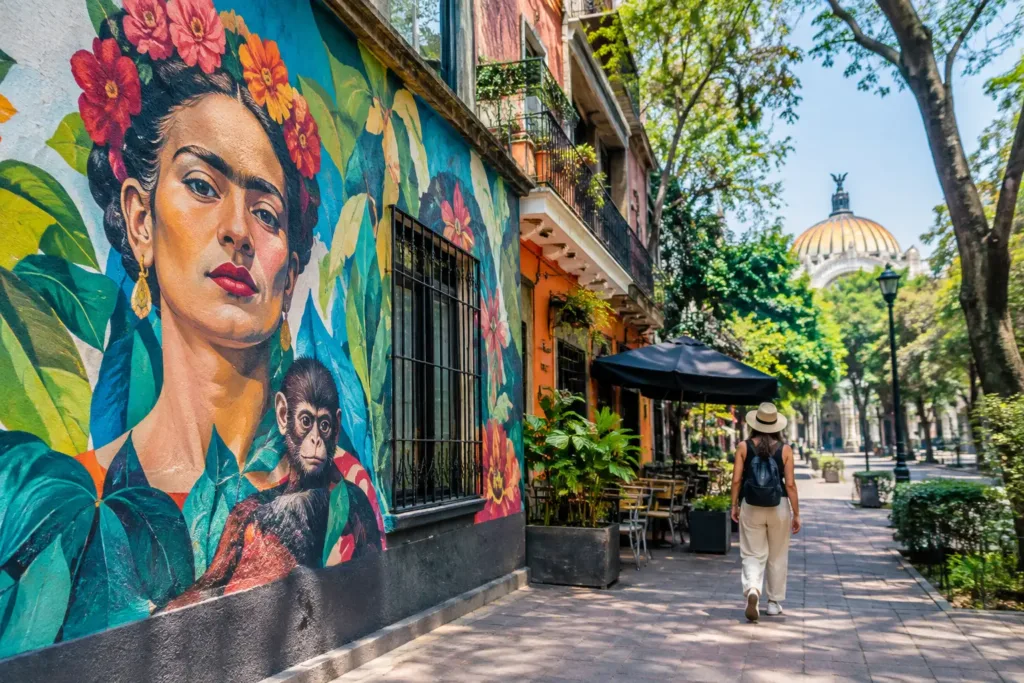
A mural in Mexico City is rarely just decoration. It may be a political argument in stone, a record of pre-Hispanic history, or a bright, temporary reply to the block around it. The best Mexico City mural locations bring those layers into focus, from landmark interiors downtown to walls you notice between coffee, lunch, and a long neighborhood walk.
Give yourself more time than you think you need. The great civic murals ask for a slow look, while the city’s street art is best experienced without treating it like a checklist. These are the places to begin, plus a few practical ways to see them with more context and less rush.
Mexico City Mural Locations: Start Downtown
Centro Histórico holds the foundational works of Mexican muralism. It can be busy, noisy, and occasionally overwhelming, but nowhere else puts so much visual history within a walkable radius.
Palacio de Bellas Artes
Begin at Palacio de Bellas Artes, where the upper-floor mural collection offers a concentrated introduction to the major voices of the movement. Diego Rivera, José Clemente Orozco, David Alfaro Siqueiros, Rufino Tamayo, and Jorge González Camarena are all represented here.
Rivera’s Man at the Crossroads is the work many visitors come to see. The mural is a recreation of his Rockefeller Center commission after the original was destroyed in New York, and it still feels pointed: industry, class struggle, science, and power collide in one vast composition. Orozco’s work carries a more skeptical, human tension. Tamayo brings a different temperature altogether, with color and form that pull away from the overtly narrative style of the earlier muralists.
This is a strong first stop if you have only one morning for murals. Go early, then step outside and notice how quickly the conversation shifts from museum scale to the street.
Secretaría de Educación Pública
A few blocks away, the Secretaría de Educación Pública contains an extraordinary group of Rivera murals across its courtyards and corridors. Painted in the 1920s, they show workers, festivals, rural life, revolution, and Mexico’s cultural traditions with a directness that makes the building feel like a public archive.
The setting matters as much as any individual panel. As you move through the courtyards, the murals unfold in sequence rather than as isolated masterpieces. Access and entry procedures can change because this is a working government building, so treat it as a planned stop rather than an automatic walk-in.
Antiguo Colegio de San Ildefonso
For a more atmospheric encounter, head to Antiguo Colegio de San Ildefonso. The former school is one of the places where Mexican muralism took shape after the Revolution, and its architecture gives the art room to breathe. Orozco’s early murals are especially compelling here: ambitious, uneasy, and far less polished than the simplified version of national history often associated with the movement.
The building also hosts temporary exhibitions, which makes it worth visiting even if you have seen the major downtown murals before. It is the kind of place that rewards looking up, lingering in a quiet courtyard, and letting the scale register.
Mercado Abelardo L. Rodríguez
Mercado Abelardo L. Rodríguez is a more surprising downtown stop. Inside this market, murals from the 1930s bring social themes directly into a daily setting of produce stalls, food counters, and neighborhood trade. Several artists contributed, including students and collaborators connected to Rivera.
The work has a rougher, more immediate energy than the polished museum experience at Bellas Artes. Visit with respect for the people doing their shopping and working their stalls. This is a market first, not a staged attraction.
Campus Murals at UNAM
Ciudad Universitaria, the main campus of the National Autonomous University of Mexico, is one of the city’s essential cultural landscapes. It is farther south than the downtown circuit, so pair it with Coyoacán or give it its own afternoon.
The Biblioteca Central is the visual centerpiece. Juan O’Gorman covered its exterior with an enormous stone mosaic that narrates Mexico’s history through pre-Hispanic imagery, colonial references, modernity, and the university’s intellectual life. It is often called a mural, though its mosaic construction is part of what makes it so striking. Walk around all four sides rather than photographing only the famous facade.
Nearby, the Rectoría building features monumental works by David Alfaro Siqueiros, including The People to the University, the University to the People. His dramatic angles and sculptural surfaces make the building feel active even from a distance. This is public art designed for movement: approach it from different sides, then step back across the plaza to understand its scale.
UNAM works best on a weekday morning or late afternoon, when campus life gives the architecture its intended rhythm. The trade-off is that galleries and some indoor spaces may have their own schedules, while exteriors remain the most dependable part of the visit.
The Siqueiros You Can See in One Stop
Polyforum Cultural Siqueiros, beside the World Trade Center in the Napoles neighborhood, is hard to miss. Its exterior is wrapped in Siqueiros’s La Marcha de la Humanidad, a vast visual statement about humanity, conflict, and collective progress. The building itself looks almost extraterrestrial against the surrounding avenue.
The interior has faced periods of limited access and changing programming, so do not build your day around entering the forum unless you have confirmed current availability. Still, the exterior alone is worth seeing, especially if you are interested in how muralism expanded beyond institutional walls into architecture on a grand civic scale.
Roma, Juárez, and the Living Wall
The murals of Roma Norte, Roma Sur, and Juárez are a different experience. Here, paint may appear on a side street, a shutter, a restaurant wall, or the edge of a construction site. Some pieces are commissioned; others are made with permission in spaces that will eventually change. Their temporary nature is part of the point.
Start around the streets near Mercado Medellín and wander toward Álvaro Obregón, keeping an eye on side facades rather than expecting a single signature work. Roma Sur often feels quieter and less performative, with more time to notice small interventions on residential blocks. In Juárez, the area around Calle Havre and the streets leading toward Reforma can offer a similar mix of galleries, old buildings, and changing wall art.
There is no reliable permanent map for this part of the city, and that is precisely why it rewards walking. A mural you saved months ago may be painted over. Another you never planned to find may become the image you remember most. Build in a coffee stop, browse a bookstore or design shop, and let the neighborhood set the pace.
Street art also deserves a different kind of etiquette. Photograph the work, but do not block a narrow sidewalk, lean on private gates, or treat residents as background scenery. If a wall sits beside someone’s front door, take your photo and move on.
How to Plan a Better Mural Day
For a first visit, choose one of two rhythms. Downtown is best for a concentrated view of Mexico’s mural movement and can fill half a day when you include Bellas Artes, San Ildefonso, and the SEP building. UNAM is better when you want architecture, open space, and a slower afternoon away from the center.
Avoid trying to combine Centro Histórico, UNAM, and Roma in one ambitious circuit unless you are comfortable spending much of the day in traffic. Mexico City distances can look modest on a map but feel very different at street level. Two well-chosen areas will give you a richer experience than five rushed photo stops.
Bring water, wear shoes suited to uneven sidewalks, and keep a light layer for rain or strong afternoon sun. Most importantly, check current entry details for public buildings and cultural venues on the day of your visit. Security rules, closures, and exhibition schedules can shift without much notice.
The city’s mural tradition is not frozen behind glass. It continues in markets, campuses, government buildings, and ordinary streets where the next coat of paint may change the view. Leave room in your route for that surprise. Often, the most memorable wall is the one you find while walking to somewhere else.