
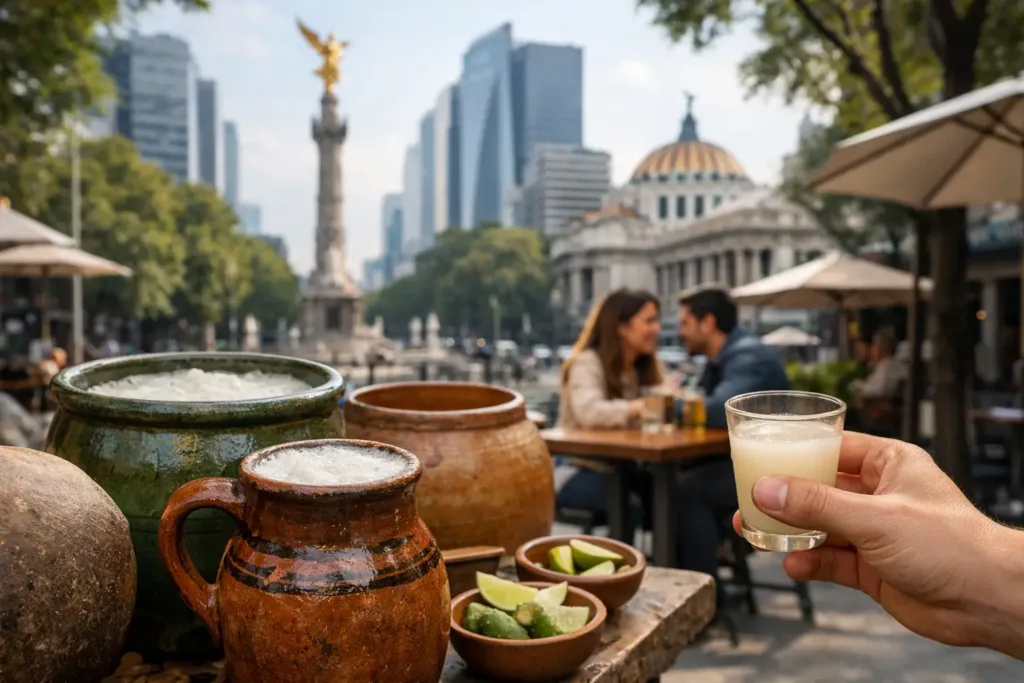
At a pulquería, the first thing you may notice is not the drink but the room: painted walls, a favorite song playing too loudly, regulars leaning into long conversations, and large glasses arriving at neighboring tables. Mexico City pulque belongs to this kind of setting. It is social, unhurried, a little unpredictable, and far more alive than the bottled version many travelers have encountered.
For visitors drawn to the city through food, design, and neighborhood life, pulque offers a direct line to a tradition that has never become a museum piece. Order a glass, take your time with it, and let the experience be as much about the place as the drink.
Mexico City pulque begins with maguey
Pulque is a lightly alcoholic fermented drink made from aguamiel, the sweet sap of the maguey plant. Maguey is a type of agave, but pulque is not tequila or mezcal. Those spirits are distilled, often smoky, and shelf-stable. Pulque is fermented and perishable, with a milky appearance, a gentle tang, and a texture that can range from silky to slightly viscous.
The process starts in the highland regions around central Mexico, where a trained producer carefully collects sap from a mature maguey. The aguamiel is then fermented, traditionally with a little of a previous batch to encourage the living culture. What reaches Mexico City is best consumed fresh. Its flavor changes quickly, which is part of its appeal and the reason a good glass can feel so specific to the day.
Natural pulque tends to be mildly sour, mineral, faintly yeasty, and surprisingly refreshing once you adjust your expectations. Its alcohol level varies by batch, but it is generally lower than wine and can still sneak up on you over a long afternoon. If your first sip feels unusual, give it a few more. This is not a drink built for instant familiarity.
A drink with a long, complicated history
Pulque was consumed in central Mexico long before the Spanish arrival, with ceremonial and everyday roles that shifted across communities and eras. It became a major urban drink during the colonial period and into the 19th century, when pulquerías were a defining feature of city life. By the 20th century, beer marketing and changing ideas of modernity pushed it to the margins, often with classist stereotypes attached.
Its current revival is worth celebrating, but it is not a rediscovery. Families, producers, and longtime neighborhood pulquerías kept the tradition present. Newer bars and younger drinkers have expanded its audience, sometimes with polished interiors and inventive flavors. Both worlds can be worthwhile. The key is to recognize pulque as a living practice, not a novelty waiting to be photographed.
What to order at a pulquería
Start with a small glass of natural pulque, often called blanco. It is the clearest way to understand the base drink before fruit enters the picture. If you like tart dairy, sour beer, kombucha, or fresh yogurt, you may warm to it immediately. If not, a curado is an easy next step.
Curados are pulque blended with fruit, nuts, grains, or other flavorings. Guava, strawberry, mango, pineapple, oatmeal, celery, and even pine nut are common possibilities, though the selection depends on the season and the house. A well-made curado should still taste like pulque beneath the fruit. If it is overly sweet or thick in a way that feels artificial, try another flavor or another venue.
Ask what is freshest that day. That simple question is more useful than ordering the most unusual option on the board. A server may also offer a tasting before you commit to a large glass, especially if the place is quiet. If you are with friends, order two or three flavors to share. Pulque changes as it warms, so this is one drink that rewards a little curiosity.
The glass itself may be called a tarro, a jarro, or simply a vaso, depending on the place. Large servings are traditional, but there is no need to prove anything. A smaller pour lets you taste thoughtfully and leaves room for food.
Where to drink pulque in Mexico City
Mexico City has long-standing pulquerías with deep neighborhood roots, as well as newer spots that make the drink approachable for a first-time visitor. The right choice depends on the kind of afternoon or evening you want.
Older-style pulquerías often feel most at home in central and working-class neighborhoods, where the pace is direct and the crowd may be mostly regulars. They can be the more memorable choice if you arrive with respect, order without fuss, and accept that the atmosphere is not curated for visitors. Some open early and are best experienced in daylight, when people stop in for a drink and a conversation before moving on with their day.
Contemporary pulque bars are easier to find around neighborhoods popular with food-focused travelers, including Roma, Condesa, Juárez, and the historic center. They may have shorter menus, cleaner design, music programs, and a stronger focus on curated flavors. That can be a comfortable entry point, particularly if Spanish is not your first language. The trade-off is that the setting may feel less rooted in the everyday rhythm that makes a traditional pulquería so compelling.
Neither format is automatically better. A neighborhood classic can be rough around the edges and exceptional. A modern bar can introduce you to a careful, fresh product and a thoughtful menu. Look for a busy room, a menu that changes with availability, and staff who can tell you what arrived fresh. Those are better signals than a place built around a photogenic mural.
A few good manners go a long way
Pulquerías are casual, but casual does not mean careless. Do not assume every traditional room is a performance for travelers. Take photos selectively, especially of people. Keep your voice measured, tip as you would at any local bar, and avoid treating the drink as a dare.
If you are visiting with a group, remember that a small, historic spot may not be set up for loud celebrations or large tabs. Go earlier, keep the group compact, and ask before rearranging tables. The best experiences usually come from matching the pace of the room rather than trying to remake it around your itinerary.
Pair pulque with a real meal
Pulque can work beautifully with Mexico City’s more satisfying everyday foods. The acidity cuts through rich carnitas, chicharrón, quesadillas, and tacos filled with slow-cooked stews. A savory snack of peanuts, chips with salsa, or a simple antojito also gives the drink some structure, especially if you have not eaten much.
A fruit curado may sound like an afternoon dessert, but it can still be filling. Oatmeal and nut-based versions are particularly substantial, while a bright guava or pineapple curado is often better in warm weather. Let appetite guide you. There is no single correct pairing, and the menu at a pulquería may be modest by design.
For remote workers and long-stay visitors, pulque is better saved for after the laptop closes. Its relaxed alcohol content can make it seem like a casual daytime drink, but the effects build gradually. Plan a walk, a museum visit, or dinner afterward, not a demanding work block.
Let freshness guide the experience
The most useful thing to know about Mexico City pulque is that consistency is not the point. A batch may be sharper one week, softer the next, more fragrant in the morning, or nearly gone by late afternoon. Supply, temperature, fermentation, and the route from producer to city all leave their mark.
That variability asks for a different kind of attention. Rather than searching for the one definitive glass, visit a place that feels good, ask what is fresh, and taste what is being poured now. You may prefer a natural blanco at one pulquería and a guava curado somewhere else. That is not a failure of taste. It is exactly how a living drink should be enjoyed.
Leave space in your Mexico City plans for an hour that does not need optimizing. Find a seat, order something fresh, and let pulque introduce you to the city at its most conversational.