
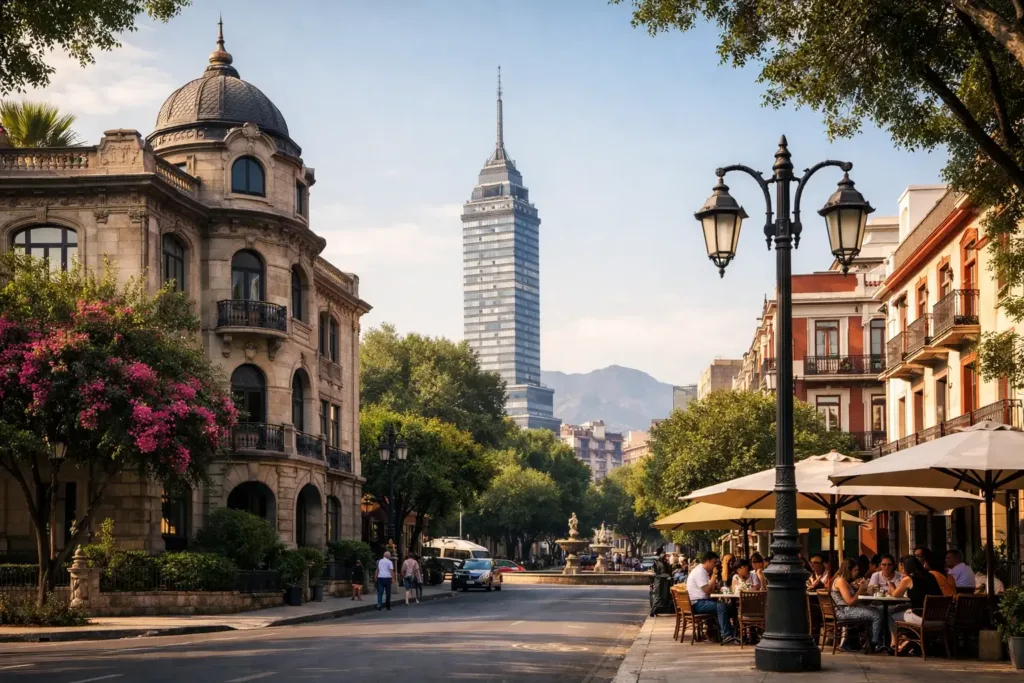
A walk through Roma can feel like moving through several Mexico Cities at once. A faded Belle Époque mansion sits beside a coffee bar, a neighborhood market, a small gallery, and an apartment building with earthquake-era repairs visible in its façade. The history of colonia roma is not a neat story of rise, decline, and revival. It is a story of reinvention, community, loss, and the everyday life that kept the neighborhood meaningful through each change.
For travelers, that layered history is part of Roma’s appeal. Its best details are not always behind a museum door. They are in the unusually wide sidewalks, the tree-lined medians, the mix of architectural styles, and the lingering sense that this neighborhood has always been a little ahead of the city around it.
Roma Began as a Modern Edge of the City
At the turn of the 20th century, Mexico City was expanding quickly under the long rule of Porfirio Díaz. The capital’s wealthier residents were beginning to move beyond the old historic center, drawn to new residential districts designed with European ideas of order, elegance, and public space.
Colonia Roma was developed beginning around 1902 on former ranchland and agricultural property west of the city. Its name referenced Rome, part of a broader fashion for European names and aesthetics among the city’s elite. The neighborhood was planned with broad avenues, landscaped traffic circles, and generous residential lots – a marked contrast to the denser colonial streets closer to the Zócalo.
Avenida Jalisco, now Avenida Álvaro Obregón, became one of the neighborhood’s grand boulevards. Its central median and rows of trees still give the street a ceremonial rhythm. Avenida Veracruz, now Avenida Insurgentes, connected the new colony to the rest of the growing city. These were not just practical roads. They announced a vision of Mexico City as a cosmopolitan capital.
La Romita Was Here First
Roma’s polished early-20th-century plan did not erase everything that came before it. Tucked within the neighborhood is La Romita, a much older settlement with roots that stretch back to the colonial period and, in local memory, earlier Indigenous communities.
Its narrow lanes and small-scale buildings feel distinctly different from Roma’s avenues. The Church of Santa María de la Natividad de Aztacalco remains a useful landmark for understanding that contrast. La Romita is a reminder that Roma was built over an existing landscape, not on empty ground. It also remains a lived-in enclave, deserving the same respect as any residential part of the neighborhood.
The Porfirian Dream in Brick, Stone, and Tile
The early history of Colonia Roma is written most clearly in its architecture. Wealthy families, professionals, and foreign residents commissioned homes that borrowed from France, Italy, England, and Mexico’s own colonial traditions. The result was eclectic rather than uniform: Beaux-Arts flourishes, Art Nouveau curves, neoclassical columns, stained glass, ornate ironwork, and tiled interiors often appear within a few blocks of one another.
This was a neighborhood built to be seen. Homes turned their façades toward the street, while gardens and porches softened the transition between public life and private space. Even after decades of adaptation, many streets retain the pleasure of visual surprise: carved stone around a doorway, a glazed tile panel, an unexpected turret, or a century-old tree shading a corner.
Casa Lamm, a restored early-20th-century residence on Álvaro Obregón, offers one of the clearest examples of Roma’s original domestic grandeur. Its current cultural life is equally telling. Across the neighborhood, former homes have become bookstores, studios, restaurants, design spaces, and community-oriented businesses. Reuse has helped many historic structures remain part of daily life rather than becoming frozen monuments.
Revolution Changed Who Lived Here
The Mexican Revolution disrupted the social order that had shaped Roma’s first years. Some of the original elite families left, while the neighborhood gradually became home to a broader mix of middle-class households, professionals, artists, and public figures.
Roma was never a museum district, and its character kept changing through the 1920s, 1930s, and 1940s. New apartment buildings appeared beside mansions. Commercial activity grew along its main avenues. The neighborhood became more urban, more practical, and more socially mixed.
That transition matters because it explains why Roma feels less formal than some of Mexico City’s planned residential enclaves. Its grandest buildings are balanced by corner stores, modest walk-ups, repair shops, schools, and small family businesses. The neighborhood’s richness comes from that overlap, not from architectural beauty alone.
Public Spaces That Hold the Memory
Plaza Río de Janeiro is one of Roma’s most recognizable gathering places, with its fountain and replica of Michelangelo’s David. Around it, the curved edges of surrounding streets and the mix of homes and apartment buildings show how the neighborhood evolved beyond its first wave of mansions.
Plaza Luis Cabrera offers another version of Roma: less monumental, more everyday. People meet there with dogs, coffee, children, laptops, and grocery bags. For visitors, these plazas are not simply photo stops. Sit for a while and you can feel how local life gives historical places their present-tense energy.
Earthquakes Left a Lasting Mark
By the 1960s and 1970s, many older homes had been divided into apartments or converted for commercial use. As Mexico City grew outward, Roma was no longer the city’s fashionable edge. Some properties fell into disrepair, and investment shifted elsewhere.
Then came the devastating 1985 earthquake. Roma was among the central neighborhoods deeply affected by the disaster. Buildings collapsed or became unsafe, residents were displaced, and many properties were abandoned in the years that followed. The earthquake changed the physical fabric of the neighborhood, but it also changed how residents organized. Across central Mexico City, neighbors, volunteers, and civil groups stepped in where official response fell short.
The 2017 earthquake reopened many of those memories. Structural safety, preservation, and responsible redevelopment remain real concerns in Roma. When you notice construction fencing or a carefully reinforced façade, it is worth remembering that this city’s architecture lives with seismic risk. Preservation here is never only about appearance.
Roma’s Creative Return Came With Trade-Offs
From the 1990s onward, artists, designers, students, independent publishers, chefs, and entrepreneurs found possibility in Roma’s vacant or underused spaces. Galleries, cafés, small restaurants, and cultural venues brought new attention to the neighborhood. Its walkability, architecture, and proximity to central districts helped fuel a renewed sense of place.
That resurgence made Roma one of the city’s most talked-about neighborhoods, but it has not been uncomplicated. Rising rents and increased demand have put pressure on long-term residents and independent businesses. Some streets now feel shaped as much by visitor consumption as by neighborhood routines.
The honest way to experience Roma is to hold both truths. Enjoy the restaurants, galleries, and design shops, but do not mistake a curated afternoon for the whole story. Support long-standing businesses when you can. Keep voices low outside residences. Ask before photographing people, homes, or religious spaces. A neighborhood is not a backdrop, even when it is beautiful.
How to Read Roma While You Walk
Roma rewards wandering, especially when you look up and slow down. Start along Álvaro Obregón, then move through the side streets toward Plaza Río de Janeiro or Plaza Luis Cabrera. Notice where a grand house meets a newer apartment building, where a tiny local shop occupies the ground floor of an old residence, and where trees have outlived several generations of change.
La Romita deserves a quieter pace. So do the streets around Mercado Medellín, where Roma’s everyday food culture and its long connections to the wider Americas are more visible than on the neighborhood’s most fashionable blocks. The right route depends on your interests: architecture lovers may spend hours on calmer streets, while food-focused travelers may prefer to build their walk around a market stop and an unhurried meal.
Roma is most rewarding when you treat it as a neighborhood in motion. Its history is not contained in one landmark or one era. It lives in the space between a restored mansion and a family-run storefront, in the shade of a median, and in the ordinary rituals of people who still call these streets home. Walk with curiosity, leave room for the unexpected, and you will encounter a Mexico City that feels both historic and fully alive.