
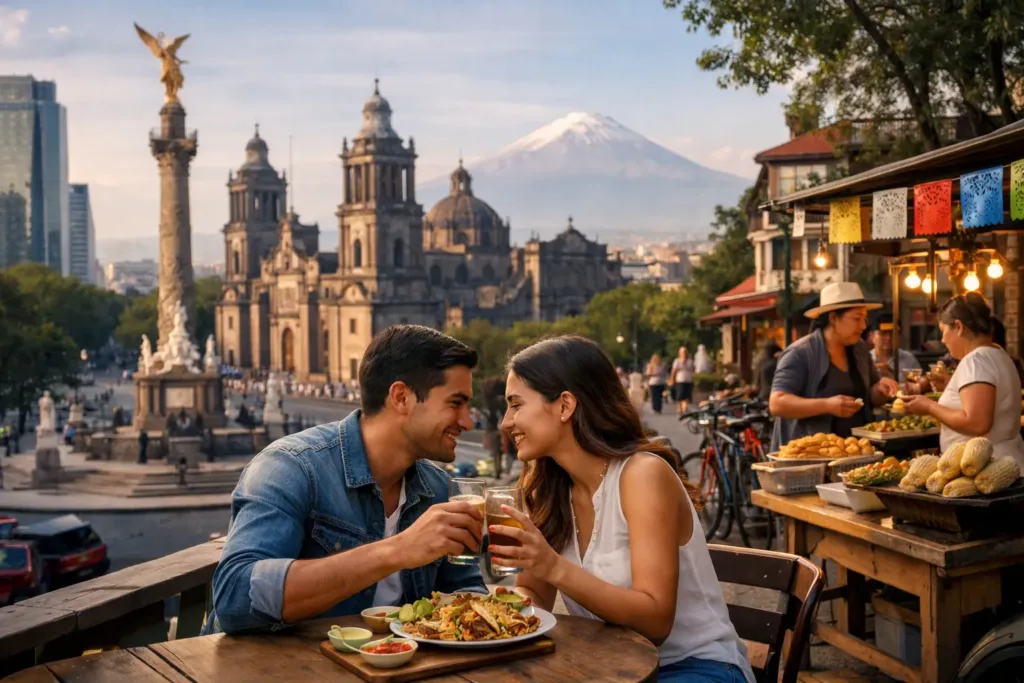
Mexico City rarely reveals itself on a checklist. A perfect morning can begin with a coffee at a sidewalk counter, turn into a long walk beneath jacaranda trees, and end hours later over tacos with people you met that afternoon. To understand how to experience Mexico City, give the city something it values deeply: your attention.
This is a place of grand museums and intimate rituals, centuries-old streets and sharply contemporary galleries, formal dining rooms and a late-night stand that makes one exceptional thing. The most memorable visits are not about seeing every landmark. They are about finding a rhythm that lets the city feel lived in rather than consumed.
Start with a neighborhood, not a map
Mexico City is vast, and trying to cross it repeatedly in a single day can turn an exciting trip into time spent in traffic. Choose one area as your anchor each morning, then let the day build outward on foot. The best discoveries are often only a few blocks apart: a florist, a small bookstore, a panadería fragrant with conchas, a courtyard restaurant hidden behind an unassuming door.
Roma and Condesa are natural starting points for travelers who care about food, design, and walkable streets. Roma Norte has a more layered, slightly scruffier creative energy, with handsome old houses alongside new restaurants and independent shops. Condesa feels leafier and more residential, especially around Parque México and Parque España. Both reward wandering, but they are not interchangeable. Spend enough time in each to notice the difference.
From there, branch out with purpose. Centro Histórico is for scale, history, and the exhilarating density of the city’s old heart. Coyoacán offers cobblestone lanes, plazas, and a slower pace. San Rafael and Santa María la Ribera can be especially rewarding when you want a neighborhood meal or cultural stop without the same concentration of visitors.
Let your mornings stay unplanned
A Mexico City morning has its own tempo. Begin early enough to see neighborhood life in motion: dog walkers in the park, office workers ordering breakfast, vendors arranging fruit, and bakeries putting out warm trays. Rather than rushing toward a major attraction, choose a café or breakfast spot and linger long enough to look around.
Order what is local to the moment. Chilaquiles can be a full breakfast, often with eggs or chicken and a choice of red or green salsa. Fresh fruit, pan dulce, and strong coffee make an equally satisfying lighter start. If a menu is unfamiliar, ask what the kitchen does best that day. People are generally happy to point you toward a favorite.
That small act of slowing down changes the rest of the day. You will notice which streets feel lively, where people gather, and which places you want to return to after sunset. For remote workers, mornings are also the most comfortable time to settle into a café for a few focused hours before the city’s energy rises.
Eat with range, not just a reservation list
The city’s food culture is too expansive for a single definition of “best.” A celebrated restaurant can be wonderful, but so can a counter serving one regional specialty with quiet confidence. Make room for both.
Plan one or two meals that matter to you, then leave the rest flexible. Eat tacos standing up at least once. Try a neighborhood fonda for a lunch that feels practical, generous, and distinctly local. Visit a traditional market, where prepared-food stalls can offer soups, guisados, fresh tortillas, juices, and more choices than you can reasonably take in at once.
A useful rule is to follow the specialty. If a place is known for barbacoa, order barbacoa. If it is a seafood spot, let that guide you. Mexico City gathers culinary traditions from across the country, so a meal can be an introduction to Oaxaca, Yucatán, Veracruz, or northern Mexico without leaving the capital.
Be thoughtful with spice rather than fearful of it. Salsa is not a single flavor or heat level, and the best approach is to taste a little first. Ask which salsa is hotter if you need to. The answer may save your lunch, or make it better.
How to experience Mexico City through its markets
Markets are among the clearest windows into the city’s daily life, but they are not all the same. Some are best for a casual meal, some for ingredients, and some for crafts, plants, or textiles. Go with curiosity, not the expectation that every market is a polished attraction.
Walk one full loop before deciding what to buy. Watch where regulars are ordering. Notice the produce, the stacks of dried chiles, the flower stalls, and the small exchanges between vendors and customers. If you photograph people or their stalls, ask first. It is a simple courtesy that keeps the experience respectful.
For a more immersive visit, arrive hungry and pick a busy prepared-food stall. The setting may be simple, but the cooking is often deeply rooted in routine and memory. A market breakfast or lunch can tell you more about the city than another generic meal ever could.
Give culture enough time to land
Mexico City’s museums deserve more than a rushed hour between meals. The major institutions can be excellent, but smaller spaces often provide the most revealing afternoon: a house museum, an experimental gallery, a design exhibition, or a neighborhood cultural center.
Choose according to your interests instead of trying to cover every celebrated name. Art lovers may want to pair a major collection with contemporary galleries in San Miguel Chapultepec or Roma. History-minded visitors can spend a full morning in Centro Histórico, where pre-Hispanic, colonial, and modern Mexico overlap in a few walkable blocks. Architecture fans should look beyond famous buildings and pay attention to apartment facades, tiled entryways, and the way old houses have been adapted for new uses.
Chapultepec is worth treating as more than a park you pass through. Its size allows for different kinds of days: a museum visit, a lakeside walk, a pause beneath the trees, or an unhurried afternoon that needs no agenda. The trade-off is time. It is better to enjoy one corner well than race across it.
Learn the city’s movement patterns
Getting around is part of the experience, and it rewards a little practical planning. Walking is ideal within compact neighborhoods, especially during the day. Ride-share services can be useful at night or when distances grow, while the Metro can be fast and economical if you are comfortable navigating a busy public system.
Traffic changes the shape of a day. A destination that looks close on a map may take much longer during peak hours, especially when moving across the city. Group your plans geographically, build in buffer time, and avoid scheduling dinner immediately after an appointment on the far side of town.
As in any major city, stay aware of your surroundings. Keep phones and valuables secure in crowded areas, use official transportation options, and trust your instincts if a street feels isolated late at night. These habits are not about anxiety. They give you the confidence to move through the city with ease.
Make room for the evening ritual
Mexico City becomes more social as the afternoon fades. Parks fill up, restaurant tables spill onto sidewalks, and a simple drink can easily become a three-hour conversation. Do not book every evening too tightly.
A good night might be a thoughtful dinner in Roma, live music in Centro, or a quiet mezcal at a small bar in Condesa. It might also be a late walk for tacos after a museum opening or a neighborhood recommendation from someone behind a café counter. The city is at its best when you leave enough room to say yes.
If you are traveling alone, sit at the bar when it feels right. It is often the easiest place to ask what to order and hear about what is happening nearby. If you are with friends, resist the urge to turn every evening into a production. One well-chosen place and a long conversation can feel more local than three stops made for the sake of variety.
Return to the places that felt good
The difference between visiting and belonging, even briefly, is repetition. Go back to the café where you had your first breakfast. Take the same park route twice. Return to a restaurant for the dish you kept thinking about. Familiarity gives a short trip texture.
Casa Aimée approaches the city with that same belief: comfort matters most when it gives you the freedom to be curious, present, and connected to the streets around you. Mexico City will always have more than you can fit into one visit. That is not a failure of planning. It is the reason to walk slowly, follow your appetite, and leave with a few favorite corners waiting for your return.