
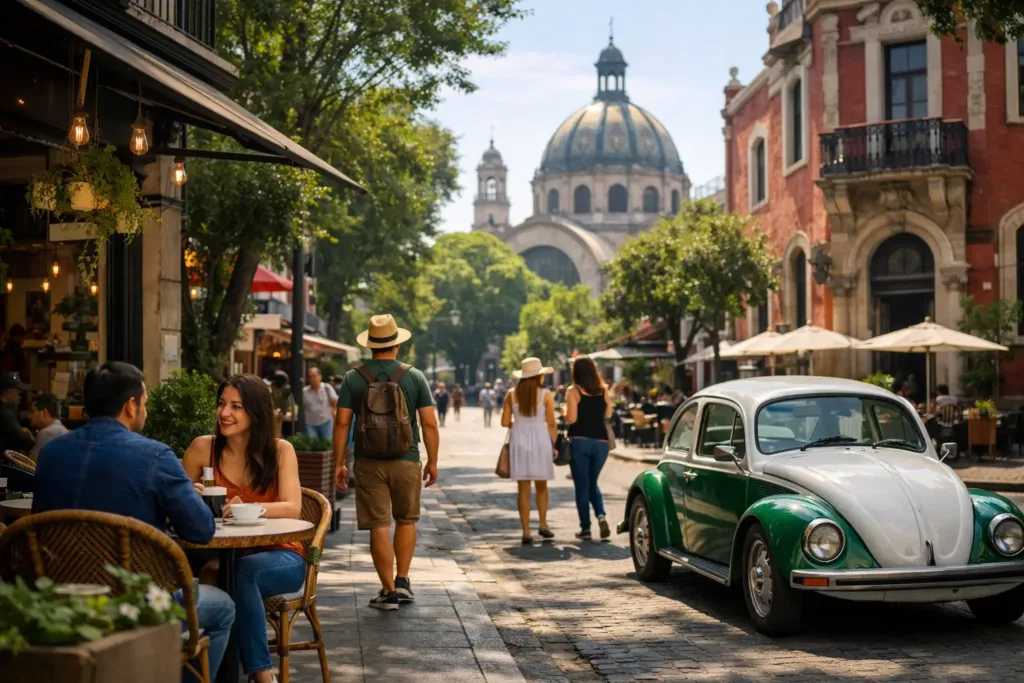
Roma is not a neighborhood you should rush through with a checklist in hand. Its best moments happen between plans: a pastry chosen because the scent pulls you in, a courtyard visible through an open gate, a new exhibition spotted while walking to lunch. If you are wondering how to explore Colonia Roma, begin by giving yourself permission to wander slowly and let the day take shape block by block.
This is one of Mexico City’s most walkable, creative, and layered neighborhoods. Early 20th-century homes sit beside contemporary galleries; tree-lined avenues lead to tiny coffee counters, long lunches, bookstores, parks, and late-night taquerías. Roma has plenty of well-known addresses, but its real character lives in the rhythm between them.
Start With Roma’s Streets, Not a Reservation
Begin in Roma Norte, ideally in the morning, when the sidewalks are calm and the neighborhood is just starting to hum. Avenida Álvaro Obregón is a useful first line to follow, with its broad median, fountains, mature trees, and mix of historic facades. From there, take the side streets rather than moving only along the main avenue.
Colima, Orizaba, Córdoba, and Jalapa are especially rewarding for architectural details: tiled entryways, stained glass, ironwork, Art Nouveau curves, and homes that reveal just enough of their inner courtyards. Roma was developed during the Porfirian era, and its elegant European-influenced buildings remain part of the neighborhood’s visual language. They are not a backdrop. They are one reason a simple walk here feels so distinct.
Keep in mind that Roma Norte and Roma Sur have different energy. Roma Norte is busier, more restaurant-forward, and often the first stop for visitors. Roma Sur is quieter and more residential, with a gentler pace and fewer crowds. Neither is better. Choose Roma Norte when you want activity and options close together; head south when you want a longer walk and room to notice daily life.
Build Your Day Around Food, With Time Between Meals
In Roma, eating well does not require chasing only the most viral table. The neighborhood rewards curiosity. Start with coffee and something small from a neighborhood bakery, then leave space for a proper lunch, an afternoon snack, and a dinner that may stretch later than planned.
Morning is ideal for a relaxed café stop. Many spots welcome laptops, but the atmosphere changes throughout the day. If you are working remotely, settle in early, order more than one drink if you are staying awhile, and avoid treating a small independent café as a free coworking office during the lunch rush. For a more focused work session, choose a place with reliable seating and return to the streets when your attention starts to fade.
For lunch, look beyond the polished dining rooms. Roma’s food culture includes market counters, neighborhood fondas, street stands, and family-run restaurants alongside chef-driven kitchens. Mercado Roma is convenient if your group cannot agree on one thing, though it is more curated than a traditional market. For a more everyday feel, visit Mercado Medellín, just across the edge of Roma in nearby La Roma/Condesa territory. Its produce, juices, spices, and prepared foods offer a colorful look at the city’s broader Latin American food culture.
Dinner is where planning can help, especially on weekends. Make one reservation for a restaurant you genuinely care about, then keep another evening unstructured for tacos, a wine bar, or whatever looks lively on your walk home. The trade-off is simple: the city’s most talked-about tables may be memorable, but an overbooked itinerary can turn Roma into a sequence of arrivals and departures instead of a neighborhood experience.
Use Culture as Your Compass
Roma’s cultural life is compact enough to encounter naturally. Small galleries rotate exhibitions frequently, independent bookstores host readings and conversations, and design shops make a pleasant pause between meals. You do not need to spend an entire day inside museums to feel connected to the neighborhood’s creative scene.
Casa Lamm is a good anchor, both for its beautiful setting and its role in the area’s cultural life. The building itself is worth seeing, with a leafy courtyard and a sense of old Roma’s residential elegance. Nearby, galleries and project spaces often feature contemporary Mexican and international artists. Check what is on before you go, but do not worry if you arrive at a small space and the exhibition is not your taste. Part of the pleasure is seeing what local artists, curators, and designers are talking about now.
Bookstores deserve equal time. Browse slowly, even if you do not read Spanish fluently. Covers, photography books, independent magazines, and bilingual selections can tell you a great deal about the creative pulse of the city. A well-chosen magazine or print is also a more personal souvenir than something bought in a hurry.
Let Parque México and Parque España Set the Pace
Roma blends naturally into Condesa, and a walk toward Parque México or Parque España is one of the easiest ways to understand how residents use this part of the city. Go in the late afternoon, when dog walkers, runners, families, and friends gathering for coffee fill the paths.
These parks are not grand sightseeing monuments. Their appeal is exactly that they are ordinary, beautiful parts of local life. Bring a drink, sit for a while, and observe. This is where a packed day can loosen up.
If you prefer a more architectural route, walk from Roma toward Condesa along Amsterdam Avenue, the oval-shaped street that follows the former racetrack. The shaded loop is especially pleasant before sunset. It can be busier on weekends, so an early weekday walk offers a quieter perspective.
Know When to Plan and When to Improvise
A thoughtful Roma itinerary needs only a few fixed points. Reserve a sought-after dinner, buy tickets in advance for a particular performance or exhibition, and schedule any appointment-based experience you do not want to miss. Beyond that, leave open space.
A useful rhythm is coffee and a neighborhood walk in the morning, culture or focused work around midday, lunch followed by a slower afternoon, then a drink or dinner after dark. This lets you experience Roma in several moods rather than only seeing its busiest hours.
Sunday is especially good for walking, lingering over breakfast, and people-watching. It is also when popular cafés and restaurants can be busiest. Tuesday through Thursday often feels more balanced for visitors who want the neighborhood’s energy without as much waiting. Many cultural spaces close on Mondays, so verify hours before building your day around one stop.
Get Around With Confidence
Roma is highly walkable, but Mexico City is large, and your feet may not be enough for every plan. Use ride-hailing services at night or when traveling farther across the city. Metro and Metrobús can be practical during the day, though they are best approached with the same awareness you would use in any major city: keep valuables secure, avoid showing your phone unnecessarily, and be mindful in crowded cars and stations.
On foot, stay alert at intersections. Traffic can move quickly, and not every crosswalk operates as visitors expect. Sidewalks may be uneven, particularly around older trees and during rainy season. Comfortable shoes matter more here than a perfectly styled itinerary.
Roma is generally lively, but street-by-street conditions vary. At night, stick to active, well-lit routes, particularly if you are walking alone. Ask locally when you arrive about the feel of the specific blocks you plan to visit. Good travel advice is rarely dramatic. It is mostly about paying attention.
Look for the Neighborhood Behind the Highlights
The most satisfying way to experience Roma is to notice what is not designed specifically for visitors. Listen for the knife sharpener’s whistle rolling down the street. Watch flower sellers set out buckets in the morning. Step into a small papelería for a notebook, order a fresh juice, or pause at a corner fruit stand.
Casa Aimée guests often find that the most memorable recommendations are not always a single restaurant or gallery. They are combinations: a morning walk on Orizaba, a long lunch nearby, a quiet hour with a book, then a night that begins with one drink and becomes a conversation with the city.
Roma will gladly give you a polished, photogenic day. But let it give you an unplanned one, too. Leave one corner unexplored, one meal undecided, and enough time to follow whatever catches your attention.